
Empower Smarter Choices with Translational Biomarkers
Translational biomarker assays with strong analytical performance deliver the critical insights needed to guide your development strategy. Our experts help you select the most appropriate methods and ensure a seamless transition from nonclinical models to clinical application, enabling smarter, faster decisions throughout your program.
Biomarker Support in Drug Development
Translational biomarkers play a critical role in early drug discovery, guiding lead selection and optimization. They address a key challenge in drug development: the uncertainty that arises from limited sample availability and the lack of reliable tools to assess therapeutic impact in humans, factors that often contribute to clinical trial failure. By providing reliable insights into therapeutic effects, they reduce risk and accelerate development.
Accelerate your journey from lab to patient by turning complex data into actionable insights. Streamline your drug development and bring life-changing therapies closer to those who need them most. Join the movement and transform scientific innovation into meaningful health outcomes.

Unlock the Full Potential of Biomarkers
Discover how to connect biomarker insights from early discovery to clinical trials to accelerate timelines, reduce risk, and improve decision-making. Our webinar shows you how to integrate the right strategies and technologies to deliver impactful data.
Watch Now
Defining the Role of Translational Biomarkers in Drug Development
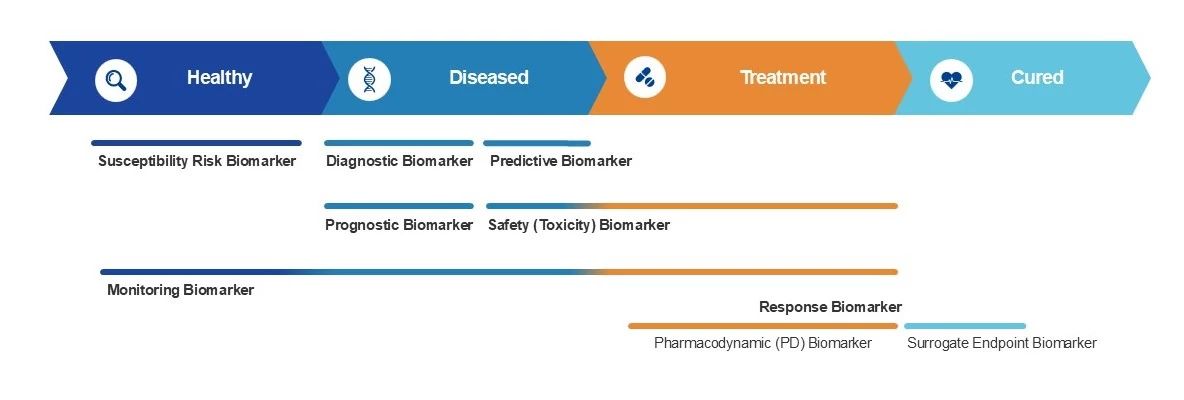
A robust biomarker strategy considers multiple factors, with the Context of Use (CoU) being paramount—defining how the biomarker or diagnostic test will ultimately be applied. Scientific understanding of disease pathology and the drug’s mechanism of action also shape the approach. A key consideration is whether specific molecules in relevant pathways have been identified as candidate biomarkers, or if agnostic “omics” technologies are better suited for discovery. This influences whether the biomarker is a single molecule or a multi-analyte classifier designed to deliver more comprehensive insights.
According to the FDA-NIH working group, eight types of biomarkers are used in drug development and are associated with their anticipated CoU in clinical practice. The FDA-NIH developed a glossary, the BEST (Biomarkers, EndpointS, and other Tools) Resource, which delves deeper into each biomarker’s identity, biological plausibility, and measurement method.
Susceptibility/Risk Biomarker
Indicates the potential for developing a disease or medical condition in an individual who does not currently have clinically apparent disease or the medical condition.
Monitoring Biomarker
Measured repeatedly for assessing the status of a disease or medical condition or for evidence of exposure to (or effect of) a medical product or an environmental agent.
Diagnostic Biomarker
Used to detect or confirm the presence of a disease or condition of interest or to identify individuals with a subtype of the disease.
Prognostic Biomarker
Pinpoints the likelihood of a clinical event, disease recurrence, or progression in patients who have the disease or medical condition of interest.
Predictive Biomarker
Help identify individuals who are more likely than similar individuals without the biomarker to experience a favorable or unfavorable effect from exposure to a medical product or an environmental agent.
Safety (Toxicity) Biomarker
Measured before or after an exposure to a medical product or an environmental agent to indicate the likelihood, presence, or extent of toxicity as an adverse effect.
Response Biomarker
Shows that a biological response, potentially beneficial or harmful, has occurred in an individual who has been exposed to a medical product or an environmental agent. There are two types of response biomarkers:
- Pharmacodynamic (PD)
- Surrogate endpoint

eGuide: Biomarker Solutions from Discovery to Clinical Trials
Learn how strategic biomarker integration can accelerate research and de-risk pipelines to bring life-saving therapies to patients faster. This guide helps you uncover smarter ways to de-risk studies and accelerate timelines, without compromising scientific rigor.
Read the Guide
Advance Faster with Translational Biomarker Insights
Translational biomarkers can provide the insight you need to make key decisions and keep your studies progressing. By providing early evidence of biological activity and target engagement, translational biomarkers help streamline development timelines and improve the likelihood of clinical success. They enable more informed go/no-go decisions early in the discovery phase, reduce late-stage attrition, and support regulatory submissions.

Custom Assay Development
Tailored assays aligned to your targets, sample types, and regulatory needs.

Global Laboratory Harmonization
Standardized methods and protocols across sites for consistent, reproducible data.

Apollo™ Data Portal
Real-time access to study data, trends, and dashboards — anywhere, anytime.

Strategic Scientific Consultation
Expert advisory from design through delivery to align biomarkers with endpoints.
Frequently Asked Questions (FAQs) for Translational Biomarkers
-
What technologies are used to measure biomarkers?
A wide range of platforms are employed, including:
- Immunoassays (e.g., ELISA, MSD)
- Mass spectrometry
- Flow cytometry
- Molecular biology
- Genomic and transcriptomic profiling
- Imaging modalities
-
How are translational biomarkers validated?
Validation should be executed in two approaches:
- Analytical validation demonstrates that the assay is robust and provides reliable results.
- Clinical qualification demonstrates the biological relevance and correlation with pharmacological effects or clinical endpoint.
Requirements for both approaches depend on the Context of Use (CoU), which dictates the analytical requirements and sensitivity and specificity in the target population.
-
What regulatory considerations apply to translational biomarkers?
Regulatory agencies such as the FDA and EMA provide guidance on biomarker qualification and use in clinical trials.