
The Importance of Proper Pathogen Detection
The foundation of reproducible research is accurate pathogen detection. Undetected pathogens and infections will compromise animal health, introduce unwanted variables, and possibly invalidate studies, costing valuable time and resources.
Traditional pathogen detection, often involving sentinel animals, frequently does not detect all pathogens or infections. These methods require extra attention from technicians, add stress to animals, and can consume valuable cage space. In today's research environment, where biosecurity, reproducibility, and ethical standards are the key to success, facilities need a standardized, sensitive, non-invasive, and easy-to-implement way to protect their colonies.
WEBINAR
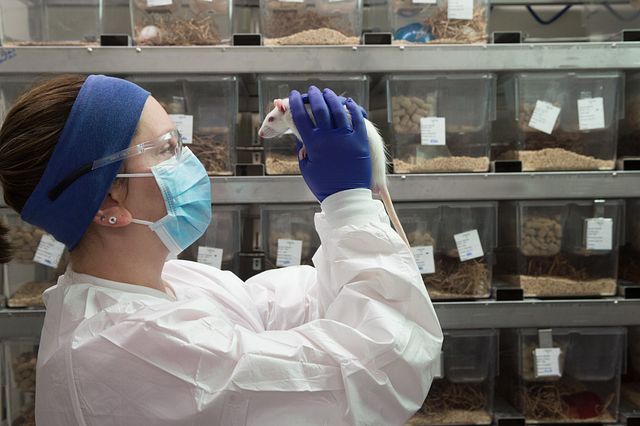
PathogenBinder: Setting the Standard for Sentinel-Free Health Monitoring and Quarantine
This webinar will show you how the PathogenBinder system can help your lab facilitate faster quarantine and improve pathogen detection by PCR. Watch on Demand
PathogenBinder: The Ultimate Solution
Through simple, sensitive, reliable detection of infectious agent particles, PathogenBinder delivers the confidence that traditional sentinels simply can't. Our solution improves sensitivity and consistency across any cage type by retrieving pathogens directly from soiled bedding and pairing them with our validated PCR testing.
This non-invasive protocol reduces animal use and technician burden while allowing your facility to align with the 3Rs (Replacement, Reduction, and Refinement) for animal welfare expectations. PathogenBinder ensures the integrity of your studies, protects your valuable colonies, and simplifies pathogen detection in one proven solution for health monitoring and quarantine.
WEBINAR
An Evolving Approach to Rodent Pathogen Detection Methods
Learn about the implementation of PCR-based methods for infectious agent detection and the evolution of using contact media exposure in soiled bedding. Watch on Demand
PathogenBinder with Electron Beam (E-Beam) Technology
All PathogenBinder kits now exclusively feature contact media treated with electron beam (e-beam) technology. In response to client requests, our decontaminated contact media delivers an added layer of protection and confidence by reducing potential exposure to contaminating microbes and the need for untested sterilization treatments.
PathogenBinder for Health Monitoring
PathogenBinder transforms health monitoring in animal colonies by efficiently detecting infectious agents, ensuring high-quality data, and reducing contamination risk through contact media. There is no longer a need for additional animals such as sentinels, valuable cage space is not lost (collection boxes are held off the rack), and there is no longer a concern that excluded pathogens aren't detected.
This easy-to-use SFSB bedding approach captures infectious agent particles from all cage types in real time. By re-exposing the contact media to the bedding at each cage change during a three-month cycle, you'll receive current, historical, and sensitive pathogen detection. Download our poster below, illustrating the simple protocol.
With validated results and a welfare-focused approach, you'll support the 3Rs by reducing animal use, streamlining monitoring, and maintaining overall colony health. Kits and supplies for any size facility and cage type may be ordered through our LTM supplies system.
Download Protocol Download Technical Sheet
PathogenBinder for Quarantine: A New Protocol that Inspires Confidence without Compromise
Quarantine has always been the first line of defense in protecting your vivarium from excluded pathogens. Now, with our new protocol – PathogenBinder for quarantine provides a standardized, validated, and highly sensitive method for quickly and reliably screening incoming animals for excluded pathogens. This provides awareness into the health status of the animals coming into your vivarium and prevents the inadvertent introduction and potential spread of excluded agents. With results in as little as two weeks, you can confidently get to your study faster. This easy-to-implement program is perfect for any size quarantine group.
Download Protocol Download Technical Sheet
Protocols: Health Monitoring vs. Quarantine
| Health Monitoring | Quarantine | |
| Purpose | Continuous surveillance of established colonies | Screening of incoming animals to prevent the introduction of pathogens |
| Timing | Ongoing, across multiple cage changes over a 3-month cycle | Short-term, post-arrival, approximately 7 days |
| Sample Source | Small bedding samples from every cage at each cage change | Transport bedding and soiled bedding from quarantine cages |
| Exposure Duration | Re-exposed at every cage change to capture current and historic pathogens | Single exposure to capture current pathogens that present a risk to your colony status |
| Agitation Time | 20 seconds for sufficient particle release and contact media capture | Increased agitation to 30 seconds for heightened sensitivity in critical screening |
| Sample Pooling | Multiple cages are pooled by rack for surveillance coverage | Cages from a single quarantined line are pooled for clearance testing |
| Outcome | Assures ongoing colony health and compliance | Confirms that new animals are free of excluded agents before integration |
| Animal Handling | No animal handling; bedding-only collection | No animal handling; bedding-only collection that replaces direct animal sampling |
| Free Collection Kits | PathogenBinder kits can be easily ordered free of charge through our LTM supplies system | PathogenBinder kits can be easily ordered free of charge through our LTM supplies system |
| Resources |
WHITE PAPER
PathogenBinder: A Refined and Standardized Soiled-Bedding Sampling Method for the Detection of Rodent Infectious Agents
Learn the best methodology for sentinel-animal free diagnostics in racks with cage-level filtration and gain insight into the studies behind the development of PathogenBinder. Download
Frequently Asked Questions About PathogenBinder
-
What is the PathogenBinder Kit used for?
The PathogenBinder Kit captures infectious agent–associated particles from soiled bedding and, when paired with our proprietary PCR assays, enables early and reliable pathogen detection in health monitoring and quarantine situations.
-
Can PathogenBinder be integrated into existing health monitoring programs?
PathogenBinder integrates seamlessly into existing workflows. It can supplement traditional sentinel programs, creating a hybrid monitoring program, replace them entirely, or be customized to align with institutional quarantine and health monitoring protocols for maximum flexibility.
-
How does PathogenBinder improve research outcomes?
By minimizing undetected infections, PathogenBinder preserves the validity and reproducibility of preclinical research. This prevents wasting money, time, resources, and datasets from becoming compromised.
-
What pathogens does PathogenBinder test for, and can it be customized?
PathogenBinder works with our ultra-sensitive PCR-based diagnostic panels to detect major rodent pathogens, such as Murine Norovirus (MNV), Mouse Hepatitis Virus (MHV), Minute Virus of Mice (MVM), Mycoplasma pulmonis, pinworms, and Helicobacter spp.
PathogenBinder has been shown to detect uncommon agents, including Sendai virus, and newly described agents, such as Clostridium cuniculi. The PathogenBinder system excels at the detection of opportunistic bacteria.
We offer panel recommendations that can be customized to meet any facility's needs.
-
How sensitive is PathogenBinder at detecting pathogens?
PathogenBinder contact media are optimized to capture and maintain infectious agent particles which can be detected by our ultrasensitive real-time PCR testing, even for agents in low prevalence or copy numbers.
-
Has PathogenBinder been scientifically qualified?
We have conducted extensive in-house qualification studies confirming PathogenBinder’s reliability and reproducibility. Our testing demonstrated the effectiveness across colony sizes, environments (including different bedding types and housing systems), model species, and facility workflows, ensuring trusted results when detecting viruses, bacteria, parasites, and protozoa.
Robust community adoption of PathogenBinder has led to both collaborative and independently conducted, peer-reviewed publications further demonstrating PathogenBinder use and utility.
Resources
Feinberg A, Nickerson KP, Woods CL, Reimer D, Henderson KS, Andersen RP, Singh B. Evaluation of Sentinel-Free Soiled Bedding as a Replacement for Direct Sampling in PCR Detection of Rodent Pathogens during Quarantine. J Am Assoc Lab Anim Sci. 2025 Jun 1:1-12. doi: 10.30802/AALAS-JAALAS-25-028. Epub ahead of print. PMID: 40683631.Woolsey JM, Bonica J, Godbey S, Washington IM. Improved Detection of Murine Pathogens Using Sentinel-Free Media Compared to Live Animal Sampling. Journal of the American Association for Laboratory Animal Science. Published online 18 July 2025. doi: 10.30802/AALAS-JAALAS-25-070.
-
How does PathogenBinder support quarantine programs?
PathogenBinder enables sensitive, line-level pathogen screening during a facility’s initial quarantine. Detecting viral, bacterial, and parasitic infections before animals leave quarantine prevents the introduction of contaminated populations into established colonies.
-
Is agitation the most effective method to transfer infectious agent particles to the contact media?
Yes. In our evaluation of various methods of exposing contact media to soiled bedding, we found agitation to be the most effective at transferring infectious agent particles to the media. This is because agitation enables the bedding to interact with all surfaces of the media, while allowing it to move through, under, and over the bedding to collect particles. Agitation maximizes the surface area available for collection, thus reducing the risk of false negatives.
-
Do I have to store the contact media in soiled bedding after sampling?
Storage of contact media with soiled bedding until the next cage change does not enhance sensitivity or provide any other benefit to infectious agent detection. In fact, wet, dirty bedding stored in an airtight container can grow mold, potentially impairing detection.
If the airtight PathogenBinder collection box is used for storage, it is strongly recommended to discard the dirty bedding after agitation. However, if a rodent cage is used and the media will be stored on a ventilated rack (i.e., air moves through the cage), the risk of mold may be lower, allowing dirty bedding to be held short-term.
-
Does the contact media require agitation with soiled bedding to collect particles, or can I just place the contact media near the soiled bedding?
The contact media requires thorough physical contact with soiled bedding to maximize the collection of particles associated with infectious agents. In our studies, agitation (by shaking and rotating the container) was found to facilitate the movement of the contact media through soiled bedding and to support optimal particle collection. This motion also promotes the capture of small particulates that settle at the bottom of the container, which can be associated with infectious agents.
Other methods of exposure, such as suspending or dropping the media over soiled bedding, sweeping it through the bedding, or simply tossing the bedding over the media, have been found to be less effective at sampling and may increase the risk of false negatives.
-
How easy is the kit to use, and what does it come with?
PathogenBinder contact media is agitated in dirty bedding collected during routine cage change. No additional training or complex steps are needed, allowing staff to integrate it seamlessly into routine operations.
Kit components include two pieces of contact media, a choice of container (small or large collection box with lid, or collection bags), and two 50 ml sterile conical tubes. Kits may be ordered without a container.
-
Do I have to use the PathogenBinder collection box for sampling?
Any clean or decontaminated container, such as an empty cage, our collection containers, e.g., PathogenBinder collection box or bag, can be used for soiled bedding collection and exposure. For best results, do not fill the container more than halfway with soiled bedding. This allows the bedding and contact media to move freely and improves the transfer of infectious agent-associated particles to the media.
-
Is the kit compatible with all cage and rack systems, and how often should it be used?
PathogenBinder is compatible with all cage and rack systems. We recommend integrating PathogenBinder into cage-change cycles for health monitoring and every time new animals are introduced into a colony (quarantine screening).
-
Can I wash the PathogenBinder collection box and is the kit environmentally sustainable?
Cleaning PathogenBinder collection boxes between quarterly use is optional (i.e., if there is no change to the known health status, then no cleaning is required). Any time an excluded agent(s) is detected, washing is required before reuse to prevent detection of residual DNA.
Note: Do NOT autoclave collection containers. PathogenBinder collection boxes and lids can be washed and decontaminated by hand or placed into an industrial cage washer at 160 – 180°F (~71 – 82°C). PathogenBinder collection boxes can also be chemically disinfected if a cage washer is not available. This lowers consumable waste and supports environmentally responsible research practices.
PathogenBinder® is a registered trademark of Charles River Laboratories, International Inc. Patent pending.