
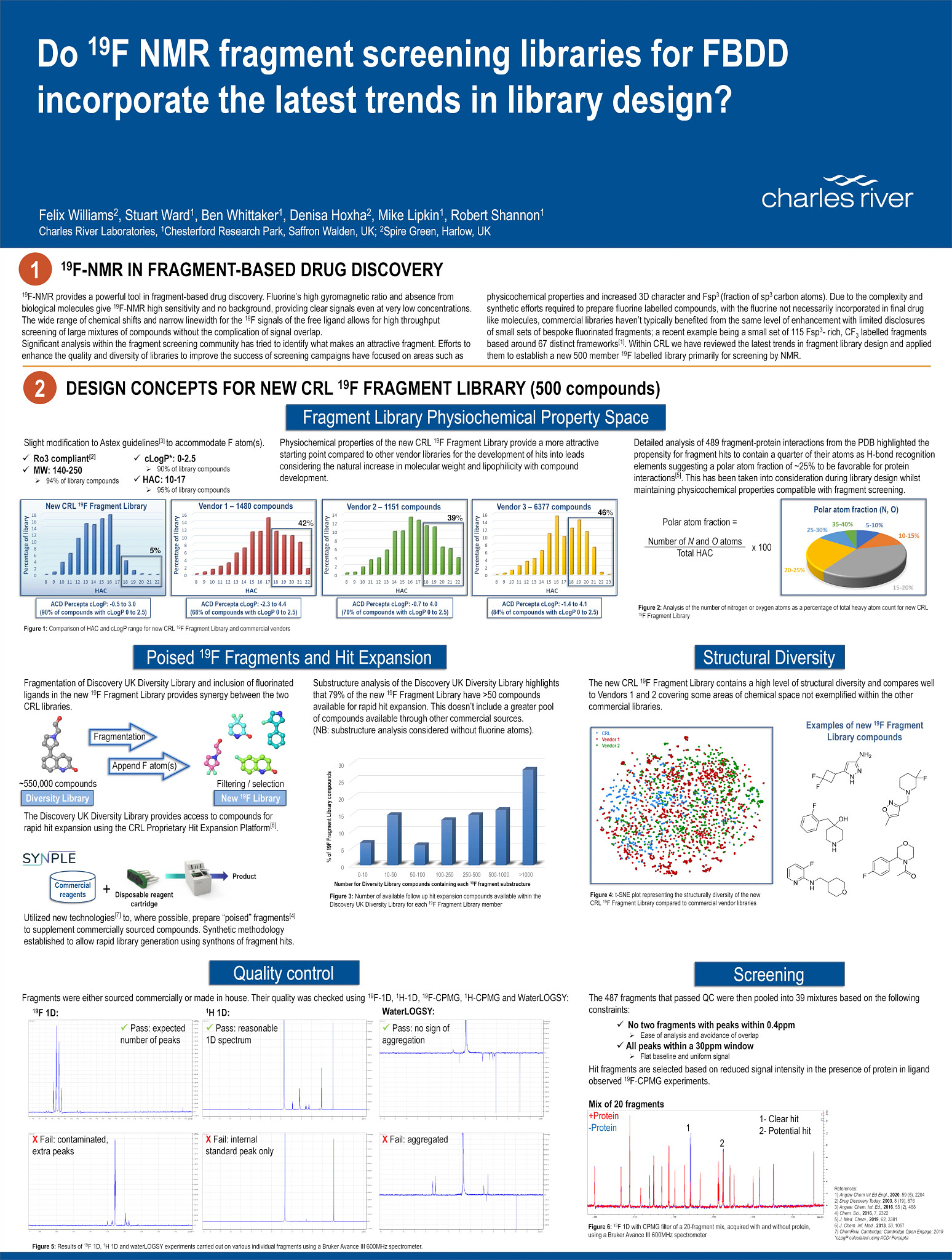
19F-NMR provides a powerful tool in fragment-based drug discovery. Fluorine’s high gyromagnetic ratio and absence from biological molecules give 19F-NMR high sensitivity and no background, providing clear signals even at very low concentrations. The wide range of chemical shifts and narrow linewidth for the 19F signals of the free ligand allows for high throughput screening of large mixtures of compounds without the complication of signal overlap. Due to the complexity and synthetic efforts required to prepare fluorine labelled compounds, with the fluorine not necessarily incorporated in final drug like molecules, commercial libraries haven’t typically benefited from the same level of enhancement with limited disclosures of small sets of bespoke fluorinated fragments.
This scientific poster “Do 19F-NMR fragment screening libraries for FBDD incorporate the latest trends in library design?” describes the process applied to establish a new 500 member 19F labelled fragment library, primarily for screening via NMR.
During development of the new library, authors reviewed the latest trends in fragment library design and applied them to establish a new 500 member 19F labelled library primarily for screening by NMR. The new Charles River 19F Fragment Library contains a high level of structural diversity, covering some areas of chemical space not exemplified within other commercial libraries.
To learn more about the 19F fragment library or screening via NMR, contact our dedicated Structural Biology team.