Chemically Induced Mouse Model of Acute Intestinal Inflammation
This acute gastroenteritis model is induced in mice by a single intraperitoneal (IP) injection of polyinosinic-polycytidylic acid (poly I:C), a synthetic analog of retroviral genomic dsRNA. Acting on the Toll-like receptors (TLRs), it induces severe mucosal injury as manifested by microscopic and biochemical changes in the villous of the small intestine. Histopathological evaluation reveals that the duodenum is the most affected by mucosal injury at 6 or 24 hours after injection of poly I:C.
Study Data & Endpoints in Poly I:C-Treated Mice of Acute Gastroenteritis
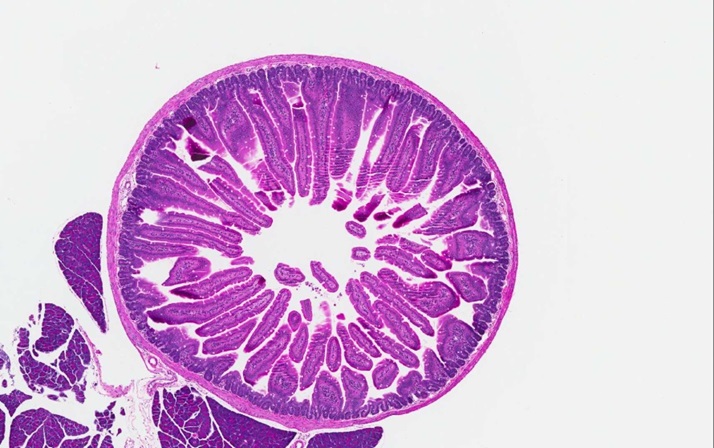
Duodenum transverse section from a control group.
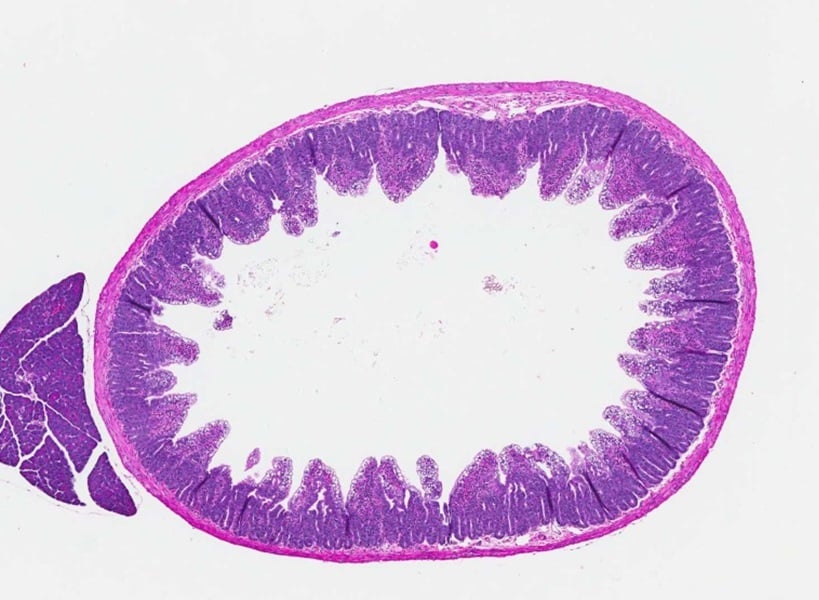
Duodenum transverse section 24h post-poly I:C treated mice. At 24 hours post-IP injection of poly I:C, villus atrophy/blunting accompanied by goblet cell hyperplasia was observed.
STUDY ENDPOINTS
- PK/PD blood collections
- Cytokine/chemokine analysis
- Histopathological evaluation