
Viral Clearance Validation Services
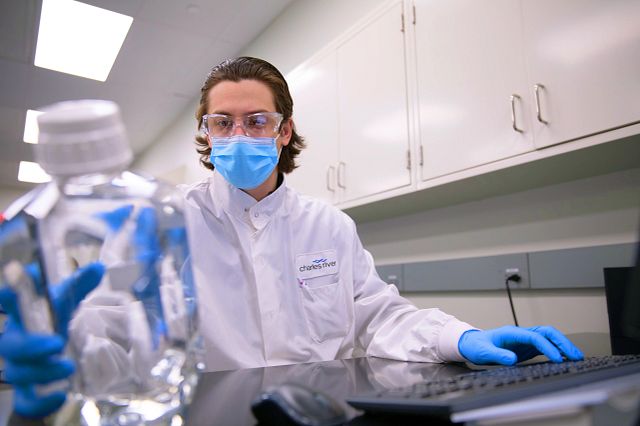
Watch this video to see the journey of a viral clearance sample at our facilities and understand the process for viral clearance studies for biological products while adhering to the new ICH guidelines.

The inherent risk of viral contamination is a commonly known and understood principle among scientists and researchers. Such contaminations can arise from the source cell line (cell substrate) itself or from adventitious viruses exogenously introduced during the production process.
Although biopharmaceuticals derived from cell lines have never been implicated in the transmission of viruses, past instances of contamination have occurred with agents whose presence was not known or even suspected. Therefore, it is critically important, and federally required, that comprehensive measures are applied to such programs to ensure, above all else, patient safety.
Products requiring viral clearance testing:
- Gene therapy medicinal products
- Monoclonal antibodies and derivatives
- Recombinant proteins
- Blood and plasma-derived products (dedicated lab)
- Animal/human tissue-derived products
- Urine-derived products
- Medical devices containing animal or human blood-derived components
- Vaccines
Interested in conducting a viral clearance study for biological products?
Talk to an Expert
Global Viral Clearance Testing Facilities and Regulatory Support
Our facilities in Wayne, Pennsylvania, and Cologne, Germany offer dedicated client labs and private client offices to support maximal productivity during on-site visits.
These sites have an array of fully qualified and validated, state-of-the-art chromatography systems along with a suite of virus filtration equipment. In addition to the dedicated client labs, we are one of the few CROs to offer access to a dedicated lab for blood product viral clearance studies.
Our laboratories in the United States and Europe have the technical and regulatory expertise. From downscale assistance to report generation, you can expect a study design, execution, and report that will support your regulatory submission without delay. We ensure viral clearance studies comply with the relevant guidelines, including new ICH guidelines, in your market:
- US Food and Drug Administration (FDA)
- European Medicines Agency (EMA)
- Paul Ehrlich Institute of Germany (PEI)
- Ministry of Health, Labour, and Welfare of Japan (WHLW)
- Medicines and Healthcare products Regulatory Agency (MHRA)
- Korean Ministry of Health and Welfare (MOHW)
- World Health Organization (WHO)
Viral Clearance: Advancements in Virus Production and Purification to Address ICHQ5A Updates
Updates to the ICH Q5A guidelines are generating new interest in virus titer and purity in viral clearance studies. Hear our experts share insights into new methods and developments in the production process of viruses you can use in your studies.
Watch Webinar
Your Regulatory Submission, Backed by Three Decades of Experience
We offer an extensive database of over 13,000 study process runs and a wide selection of both enveloped and non-enveloped viruses for your viral clearance studies. If you do not see the virus you need to conduct your study, please submit a Contact Us request and let us know what your project requirements are. We can source new viruses from our approved vendor list or coordinate a transfer from one of our many laboratories around the world.
Charles River Virus Availability
| RNA Enveloped | RNA Non-Enveloped | DNA Enveloped | DNA Non-Enveloped |
|---|---|---|---|
| Human immunodeficiency virus-1 | Reovirus type 3 | Pseudorabies virus | Human adenovirus type 5 |
| Xenotropic murine retroviruses | Poliovirus type 1 | Herpes simplex virus-1 | Simian virus 40 |
| Amphotropic murine retrovirus | Encephalomyocarditis virus | Herpes simplex virus-2 | Porcine parvovirus |
| Ecotropic murine retrovirus | Hepatitis A virus | Infectious bovine rhinotracheitis virus | Murine minute virus |
| Bovine viral diarrhea virus | Feline Calicivirus | Autographa californica nucleopolyhedrovirus (Baculovirus) | Bovine parvovirus |
| Vesicular stomatitis virus | New: Rabbitpox virus | ||
| Parainfluenza type 3 | Coming soon: Vaccinia virus | ||
| Sindbis virus | |||
| Influenza A virus | |||
| Porcine Hemagglutinating Encephalitis virus (Betacoronavirus) | |||
| Murine Endogenous Retrovirus | |||
| Zika virus |

Reducing Viral Clearance Challenges
Designing a viral clearance study is not always straightforward. Get insider tips to ensure VC success and patient safety.
Watch Webinar
ClearancePlus℠ Platform
Extensive experience with multiple product types enables us to provide support and advice tailored to each product and its requirements, including downscale assistance, execution of process steps, as well as interpretation and troubleshooting of results.
Features and Benefits
- Support with risk-based assessments – Comprehensive review of a client's viral safety testing program, production processes and raw material quality in order to minimize required viral clearance and ensure an economic study design
- Holistic study design – Review of required pretesting, virus spikes, sampling modes, detection methods and assay sensitivities to define the most effective virus clearance study approach
- Optimized sensitivity – Standard inclusion of large volume plating for all product-relevant samples to improve LRV claims and demonstrate effective and robust virus reduction
- Customized service – Extensive experience with multiple product types and purification steps, allowing us to provide support and advice tailored to each product and its requirements, including downscale assistance, execution of process steps and interpretation and troubleshooting of results
- Industry leadership – Application of best practices as determined by performance of internal studies and as presented in multiple viral safety conferences, symposia, publications and technical reports in order to define the most scientifically sound study design
Frequently Asked Questions (FAQs) About Viral Clearance Studies
-
What are viral clearance studies for biological products?
Viral clearance is a measure of the capacity of the dedicated manufacturing process steps to primarily inactivate or remove viruses.
Viral clearance studies involve deliberate spiking of viruses into process intermediates and then demonstrating their inactivation or removal during the subsequent processing steps.
This is usually done on a scaled-down version – a laboratory version – of the selected process steps. Contact us for more information on this topic.
-
Which virus should I test in a viral clearance study for biological products?
This depends on the origin of the animal or human material that has been used in production, an aspect that needs to be addressed in your risk assessment. Based on the risk assessment and keeping regulatory documents in mind the virus panel covers relevant, known and indirectly also unknown viruses because the panel will cover different biophysical features.
-
What if the viruses I need to test are not on your list?
If you cannot find a virus that you like on our list, please get in touch. Also keep in mind that not all viruses are suitable for viral clearance studies. Viruses must grow to high titers and a robust in vitro test system with a simple read-out needs to be in place. An additional consideration is the risk for people working with it and the environment which should be kept at a minimum. Additionally, it is important that the virus can be purified without any effect on its biophysical features and that it can be stored.
-
What is the most robust step to inactivate or remove a virus?
This depends on your product and the available process steps within your manufacturing process.
For antibodies or their derivatives as well as recombinant proteins the virus retentive filtration using nano filter with and average pore size of 20nm or less is the most robust step to remove any virus. For enveloped viruses, low pH (pH ≤3.7) or solvent-detergent treatments are very effective.
For medical devices H2O2 and HCL treatments have been shown to be efficiently inactivating viruses as well as radiation.
-
What do I have to provide as client for viral clearance studies for biological products?
A down-scaled process, process intermediates, and buffers. Our state-of-the-art laboratories are equipped with temperature-monitoring, deionized water, CO2 and N2 gas, and pressurized air systems. We have fully qualified and validated ÄKTA systems along with qualified standard equipment on site. If you need any specialized equipment, please get in touch.
-
Is GMP material required for viral clearance studies? Do the pre-test material and the main study material need to be from the same lot?
A viral clearance study does not necessarily require GMP material. It does make it easier though because if you are not using GMP material you must prove that the material used is comparable.
The material used for pre-test and main study does not have to be from the same lot. However, using material of the same lot reduces unwanted surprises during the testing of the process samples. Be sure to speak to your study director about this.
-
Which performance/service options are available?
You are welcome to come to our site to either perform your process steps, watch us perform them, or work together with our team to execute your process runs. Note, Charles River will always add the virus spike and will take samples from process fractions, titrate, and evaluate these.
Also, Charles River provides full service for clients by performing all viral clearance study steps (including chromatography and filtration steps) on their behalf. You can let our experienced team take care of your study, so you don’t have to travel to our site.