
GI Partners Acquires CDMO and Cell Solutions
As Rose BioSolutions, the established CDMO and Cell Solutions businesses continue to support the biotechnology ecosystem with cell sourcing capabilities and CDMO services to accelerate your advanced therapy from development to delivery.
Learn More
Which Human Embryonic Stem Cell Line is Best for You?
Human embryonic stem cells have an unlimited capacity for self-renewal and are pluripotent with the potential to differentiate into every cell type in the body, which make ES cells an extremely attractive research tool for disease modeling, developmental biology, drug screening, and regenerative medicine. We have partnered with Pluristyx to give you access to a variety of wild-type and diseased human ES cell lines for research use only (RUO).
-
Wild-Type Human Embryonic Stem Cells
We offer a wide selection of wild-type ES cell lines that are highly characterized and conform to the Global Ethical Standards and Clinical Cell Regulations with complete donor history and testing information. The wild-type ES cell lines were originally developed by either AgeX Therapeutics or University of Michigan and are intended for research use only. All wild-type human embryonic stem cell lines that we offer are registered with the U.S. National Institutes of Health (NIH) and are eligible for use in NIH-funded research.
- ESI-017 Wild-Type Human ES Cell Line
ESI-017 was originally developed by AgeX Therapeutics and was derived under current Good Tissue Practice (cGTP). ESI-017 is available as a standard bank vial size of >0.5M cells per vial or as a high-density (ready to differentiate) vial size of either 25 or 100 million cells per vial. ES cells frozen at high density can be differentiated immediately after thawing, thus eliminating the need for time-intensive and expensive pre-differentiation expansions. The ESI-017 cells are cryopreserved in 1.2 mL threaded cryogenic vials with a 1 mL fill volume. Please contact us for availability, pricing, and lead times for the ESI-017 embryonic stem cells.- University of Michigan Wild-Type Human ES Cell Lines
We also offer 22 wild-type ES cell lines that were originally developed by the University of Michigan from different donors. These ES cells conform to the Global Ethical Standards and Clinical Cell Regulations with complete donor history and testing information and are registered with the NIH. These wild-type ES cell lines are available as a standard bank vial size of >0.5M cells per vial and are cryopreserved in 1.2 mL threaded cryogenic vials with a 1 mL fill volume. Please contact us for availability, pricing, and lead times.Your company or academic institution may be eligible for pricing discounts. Government labs located in the United States are also eligible for GSA MAS discounts. Request a quote to find out more.
-
Diseased Human Embryonic Stem Cells
Disease affected human embryonic stem cells have an identified genetic abnormality that causes disease and enables research into understanding the cellular mechanisms of disease establishment and progression. We offer a wide selection of diseased ES cell lines that were originally developed by the University of Michigan for RUO applications and are registered with the NIH and are eligible for use in NIH-funded research.
Our portfolio of diseased human ES cell lines includes:
- Actin Nemaline Myopathy
- Adrenoleukodystrophy
- ALS/Frontotemporal Dementia*
- Aniridia 3-Beta-Hydroxysteroid Dehydrogenase Deficiency
- Charcot Marie Tooth Type 1A
- Cystic Fibrosis*
- Duchenne-Becker*
- Fragile X Syndrome
- Hemophilia B
- Huntington’s Disease*
- Hypertrophic Cardiomyopathy*
- Incontinentia Pigmenti
- Kennedy Spinal Bulbar Muscular Atrophy
- Marfan Syndrome
- Multiple Endocrine Neoplasia, Type 2A
- Neurofibromatosis Type 2
- Niemann Pick Type C
- Non-Syndromic Hearing Loss
- Retinoblastoma
- Robertsonian Translocation
- Smith-Lemli-Optiz Syndrome
- Spastic Paraplegia Type 31
- Spinocerebellar Ataxia Type 3
- Stickler Syndrome
- Trisomy 16
- Trisomy 21
*Charles River is the exclusive provider of these diseased ES cell lines that are produced by Pluristyx.The diseased human ES cells are highly characterized and conform to the Global Ethical Standards and Clinical Cell Regulations with complete donor history and testing information. The diseased ES cell lines are available as a standard bank vial size of >0.5M cells per vial and are cryopreserved in 1.2 mL threaded cryogenic vials with a 1 mL fill volume.
The diseased ES cells offered in our portfolio can:
- Be used to differentiate into any body tissue to study systemic effects of that disease.
- Be matched with diseased and non-diseased ES cell lines derived from siblings from the same parents, which allows for better understanding of disease establishment and progression.
- Be used to evaluate the influence of varied genetic background on disease progression, since there are multiple naturally occurring mutations available for the same disease.
Please contact us for availability, pricing, and lead times for the full list of diseased ES cell lines that we offer.
Your company or academic institution may be eligible for pricing discounts. Government labs located in the United States are also eligible for GSA MAS discounts. Request a quote to find out more.
-
High Quality Wild-Type and Diseased Human Embryonic Stem Cell Lines
QC Metric Test Specification Out-of-freeze test Cell viability ChemoMetec NC-200 ≥ 70% At-freeze test Viable cell number ChemoMetec NC-200 >0.5M viable cells Pluripotency Flow cytometry OCT-4 + SOX2 + SSEA-4 ≥ 70% Karyotype G-banding 46, XX or 46, XY normal Karyotype CS-digital PSC 24-probe
by StemGenomicsNo detected copy number variations Karyotype FISH 20p11 – BCL2L1 Normal chromosome 20 copies Sterility Biologics sterility profile and mycoplasma spp. PCR assay Negative Identity Human cell STR profiling 100% match to donor at 17 sites Your company or academic institution may be eligible for pricing discounts. Government labs located in the United States are also eligible for GSA MAS discounts. Request a quote to find out more.
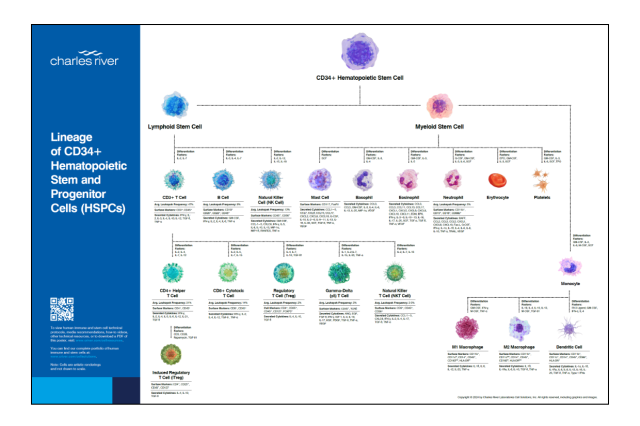
Lineage of CD34+ Hematopoietic Stem and Progenitor Cells (HSPCs)
Receive a complimentary poster to access information on immune cell markers, differentiation factors, cytokines, technical protocols, media recommendations, how-to videos, and more.
Frequently Asked Questions About Human Embryonic Stem (ES) Cells
-
Can embryonic stem cells (ES cells) be maintained in culture for prolonged periods?
Yes. If the ES cells are cultured properly, they can be maintained, undifferentiated in culture for a prolonged period. Dr. Jamie Thomson was the first scientist to isolate and maintain human ES cells in culture.
Thomson JA, Itskovitz-Eldor J, Shapiro SS, Waknitz MA, Swiergiel JJ, Marshall VS, Jones JM. Embryonic stem cell lines derived from human blastocysts. Science. 1998 Nov 6;282(5391):1145-7
-
Can ES cells be used in clinical applications?
All the human ES cell lines we offer are for research use only (RUO) and shall not be developed for diagnostic or therapeutic use.
Of note, the original seed bank for ESI-017 was procured under current Good Tissue Practice (cGTP) and conform to Global Ethical Standards and Clinical Cell Regulations and thus ESI-017 has a path to the clinic.
Crook JM, Peura TT, Kravets L, Bosman AG, Buzzard JJ, Horne R, Hentze H, Dunn NR, Zweigerdt R, Chua F, Upshall A, Colman A. The generation of six clinical-grade human embryonic stem cell lines. Cell Stem Cell. 2007 Nov;1(5):490-4.
-
What is the advantage of using Read- to-Differentiate® ES cell products?
Ready-to-Differentiate® (RTD®) ESI-017 products are frozen at a high-density with either 25 or 100 million cells per vial and using a proprietary freezing method to preserve cell viability and quality. The value of RTD® ES cells is that they can be differentiated immediately after thawing, thus eliminating the need for time-intensive and expensive pre-differentiation expansions.
-
What media are recommended for culturing embryonic stem cells?
For the ESI-017 ES cell line, TeSR-E8 medium is recommended. TeSR-E8 is a derivative of mTeSR1, which was originally developed by Dr. Tenneille Ludwig and colleagues at the University of Wisconsin.
Ludwig TE, Levenstein ME, Jones JM, Berggren WT, Mitchen ER, Frane JL, Crandall LJ, Daigh CA, Conard KR, Piekarczyk MS, Llanas RA, Thomson JA. Derivation of human embryonic stem cells in defined conditions. Nat Biotechnol. 2006 Feb;24(2):185-7.
-
At what density should the ES cells be plated?
We recommend seeding the ES cells at density of 20,000 cells/cm2.
-
Do the media need to be changed daily for the embryonic stem cells?
Yes, the media should be changed daily, and the ES cells should be passaged when at 60 – 75% confluency using non-enzymatic dissociation reagents.
-
Which cell counter should be used for counting ES cells?
We recommend counting the ES cells using ChemoMetec NC200 with A100 reagent.