
Type 2 Diabetes Models
To help your Type 2 diabetic research, we have a number of validated type 2 diabetes models available to provide valuable insight into your drug candidates, including:
- The ob/ob mouse model - The ob/ob model is a mutant mouse strain that is used in diabates and obesity research as it is obese, hyperphagic, hyper-insulinemic and hyperglycemic. This is one of the mouse models Charles River uses when running client studies.
- The db/db mouse model - The db/db mouse is often used for type 2 diabetes research, as it has a spontaneous mutation of the leptin receptor, leading to severe obesity, hyperphagia, polydipsia and polyuria.
- ZDF rat model - The Zucker diabetic fatty (ZDF) rat is another model of type 2 diabetes, as well as being used for metabolic syndrome and other related conditions. This model develops hyperglycemia and hyperinsulinemia.
- In Vitro Type 2 Diabetes Models- In addition to diabetic animal models, type 2 diabetes can also be researched in cell models, and Charles River offers a range of assays for client studies.
The ob/ob and db/db mouse models are popular, well characterized models of Type 2 Diabetes (T2D). Charles River also offers MASH models (previously NASH), Diet-Induced Obesity and complication Models, Glucose Tolerance Testing, and Dyslipidemia and Atherosclerosis Models to support your Type 2 Diabetic mouse model research, as well as a range of Type 1 Diabetes models.
What are some important considerations to select the appropriate mouse model for studying type 2 diabetes?
The best way to approach diabetic mouse model selection for the assessment of anti-diabetes therapies is to consider the target and/or mechanism of action. No one model faithfully recapitulates diabetes as it occurs in humans, but many models are quite useful in the discovery and development of effective therapeutics. Some considerations include presence of the target under investigation and its involvement in some aspect of diabetes, the translatability of the model to human disease, response to clinical standards of care, and the presence of a pharmacodynamic biomarker.
Biologic therapies developed against human targets must consider the potential for recognition of the paralogous molecule in a different species without inducing an immune response. Demonstration of an effect of the target on the etiology and pathogenesis of disease in a transgenic model (either knock out or overexpression) provides a great deal of confidence that the model and target are relevant. In most instances, demonstration of efficacy in more than one animal model increases assurance in the approach.
Our experts are available to answer any questions you may have on model selection and can work with you to choose the most appropriate model for your type 2 diabetes research.
Optimize Your Diabetes Study Design
Overcome the regulatory challenges of toxicity testing for your diabetes therapy with strategic study designs.
View Webinar
ob/ob Mouse Model
The ob/ob mouse model is a monogenic model of type 2 diabetes. The animals are homozygous for a mutation in leptin and develop obesity, hyperphagia, glucose intolerance, insulin resistance and transient hyperglycemia. With age, hyperglycemia wanes in these mice due to compensating hyperinsulinemia.
-
ob/ob Mouse Model Validation Data
Effect of Standards of Care on Body Weight in ob/ob Mice
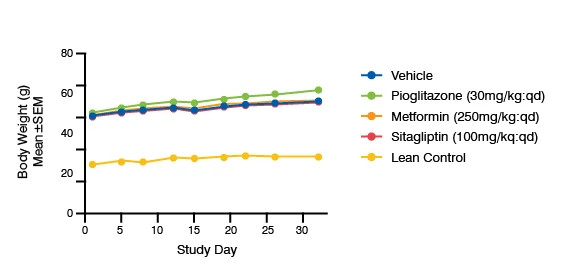
Male, ob/ob mice were treated with the indicated test articles for 32 days.
db/db Mouse Model
The db/db mouse model is also monogenic, insulin-resistant model of type 2 diabetes, due to a spontaneous mutation in the leptin receptor. Similar to the ob/ob strain, the animals are obese, hyperinsulinemic (for a portion of their lives), insulin resistant, and hyperglycemic. This is a more robust type 2 diabetes model that can progress to severe depletion of pancreatic islets and death by 10 months.
-
db/db Mouse Model Validation Data
Effect of Standards of Care on Body Weight in db/db Mice

Male, ob/ob mice were treated with the indicated test articles for 32 days.
ZDF Rat Model
The Zucker Diabetic Fatty (ZDF) model is an obese, insulin-resistant, and glucose-intolerant ratl and an excellent model of pancreatic exhaustion. Initial hyperinsulinemia declines with time, accompanied by deterioration in glycemic control. The ZDF strain initially presents as modestly hyperglycemic accompanied by a state of considerable insulin resistance. Over time, the pancreas becomes exhausted, insulin secretion decreases (as it does in late stage human diabetes), and plasma glucose increases.
-
ZDF Rat Model Validation Data
Development of Diabetes in Male Zucker Diabetic Fatty Rats
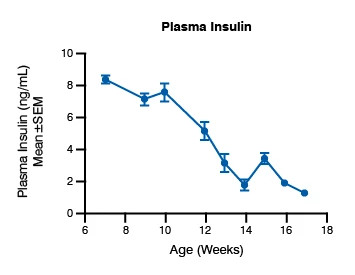
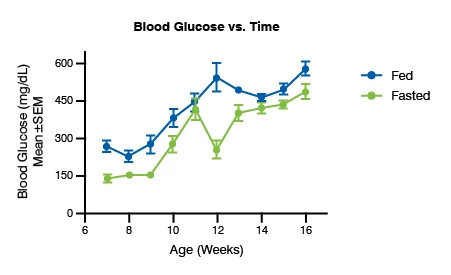
Plasma insulin and blood glucose were followed in male ZDF rats that were fed LabDiet 5008. In the morning, non-fasting blood glucose was determined at about the same time of day on each occasion. Fasted blood glucose was obtained following an overnight fast.
Effect of Standards of Care on Glycemic Control in Male Zucker Diabetic Fatty Rats
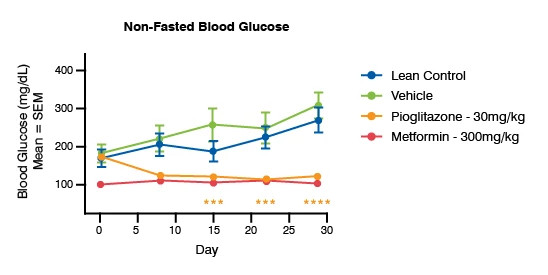
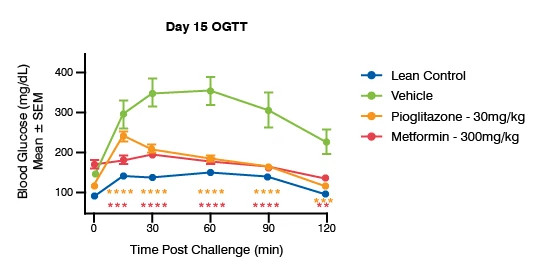

In the morning, non-fasting blood glucose was determined in male ZDF rats at about the same time of day on each occasion. The indicated test articles were administered over the course of the study. An oral glucose tolerance test (OGTT) was administered to each animal following 14 days of treatment. Total glucose exposure during the OGTT was calculated by determining the area under the curve (AUC) for blood glucose versus time.
Glucose Tolerance Testing for Type 2 Diabetes Mouse Models
The glucose tolerance test (GTT) can be used to assess the ability of your compound to enhance glucose handling following acute or chronic administration in rodents. With quick study initiation and rapid turnaround times on data generation, the GTT can collect information on gut hormone responses, changes in hepatic glucose output, and whole-body glucose disposal in the postprandial state. As a quick go/no-go on an inexpensive platform, it is ideal for investigating multiple routes of compound and glucose administration (PO, IP, IV, SC and IM) to advance your discovery program to the next step.
Ready to find the model that is best suited for your current and future diabetes mouse models research? Charles River’s team of experts can help identify the best model, and run the studies, to provide you with the data you need.
In Vitro Type 2 Diabetes Models
In addition to the established animal models, we also offer a variety of in vitro assays to study multiple aspects of Type 2 Diabetes across diverse modalities, including small molecules, biotherapeutics (e.g. antibody incl. multi-specific, nanobodies, peptides, proteins, PROTAC, LYTAC), antisense oligonucleotides, and mRNA. These assays utilize human primary adipocytes, hepatocytes/ hepatic stellate cells, skeletal muscle cells, pancreatic cells. As examples in human primary hepatocytes, the glycogen accumulation assay is a valuable tool to identify test articles that modulate stored or circulating glucose. The Glucose uptake and Glut4 translocation assays in human primary skeletal muscle cells allow for identification of insulin-mediated glucose uptake regulators. Steatosis and lipidosis assays are also available in human primary hepatocytes.
In Vitro Diabetic Model Data
-
T2D - Glycogen Accumulation Assay
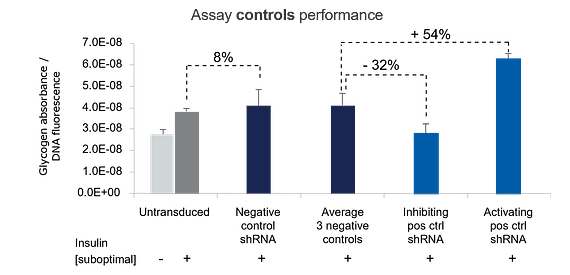
Performance of control conditions in Glycogen accumulation assay, suitable to identify modulators of glycogen accumulation in human primary hepatocytes. -
T2D - Glucose Uptake Assay
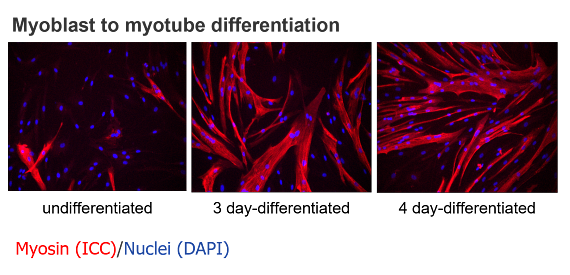
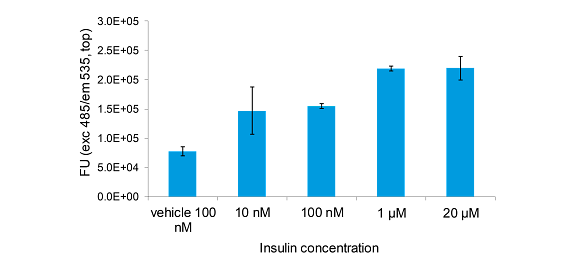
The Glucose uptake assay is suitable for identifying modulators of insulin-mediated glucose uptake in human primary skeletal muscle cells, using a fluorescent glucose analog. -
T2D - Glut4 Translocation
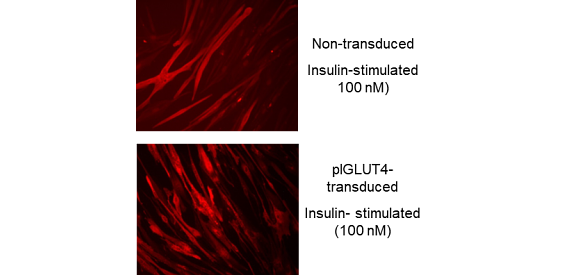
Elevated glucose uptake in skeletal muscle cells can also be tested by the insulin-mediated translocation of Glut4 from the cytosolic vesicles to the cell membrane. -
T2D - Steatosis Assay
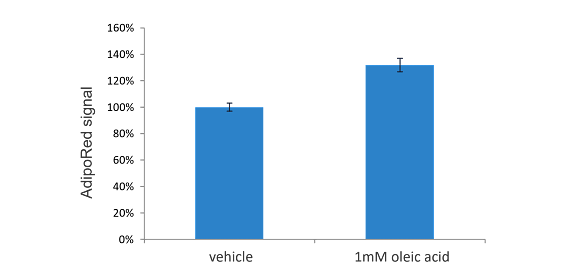
Assay performance of the Steatosis assay in human primary hepatocytes, using an AdipoRed™ readout.
In addition, in human hepatic stellate cells from healthy and MASLD donors, a high throughput, high content-based assay was developed to measure TGF-β1-induced Stellate-to-Myofibroblasts Transition (SMT) to facilitate MASH drug discovery.
Ready to find the model that is best suited for your current and future diabetes mouse models research?
Frequently Asked Questions (FAQs) for Type 2 Diabetes Mouse Models
-
What are some commonly used animal models for studying type 2 diabetes?
We offer several diabetes mouse and rat models that are routinely employed for studying diabetes, including:
- The ob/ob mouse model
- The db/db mouse model
- ZDF rat model
-
What end points are used to evaluate efficacy of test articles in diabetes mouse models?
Several markers of glycemic control are routinely used in animal studies of diabetes; the most common ones include:
- Tolerance tests to assess glucose disposal, insulin sensitivity, and hepatic glucose output
- Concentration of serum insulin
- Non-fasting and fasting levels of blood glucose
- Body composition
- Food intake levels
- Serum lipids
- Liver lipids
- Serum adipokines
Be sure to incorporate histology and biomarker assessments when conducting research into type 2 diabetes.