
Charles River's Rodent Cognition Tests
Cognition includes various types of memory and learning, such as facts (semantic memory), experiences (episodic memory), and rules (procedural memory), as well as attentive processes and executive function. These processes generally require the coordination of multiple brain regions, neuronal circuits, and neurotransmitters.
Changes in cognition, learning, and memory can be successfully detected in rodent models of neurological disease, enabling cognitive tests to measure and quantify the efficacy of novel compounds and pharmacological intervention on cognition. Changes in cognition are a hallmark of neurodegenerative disorders, such as Alzheimer’s disease, Parkinson’s disease, Huntington's disease, and amyotrophic lateral sclerosis (ALS), as well as psychiatric disorders including autism spectrum disorder and schizophrenia.
Our extensive experience in this area of behavioral testing enables us to tailor custom protocols and assays to meet precise client requirements.

Machine Learning in Behavior Data Analysis
Learn how our scientists use machine learning to reduce processing time, improve reproducibility, and maximize the value of your behavior testing data.
Watch the webinar
Contextual or Cue Fear Conditioning Test
Fear conditioning tests enable the investigation and measurement of associative learning and memory by pairing an aversive stimulus with a cue and/or the context of the experiment. After repeated pairings the rodent learns to fear the conditioned cue and the training context. This form of learning is rapid, and memories formed are long lasting and stable, making fear conditioning tests a highly useful paradigm for investigating behavioral changes in disease models and the impact of therapeutics on associative learning and memory.
Fear Conditioning Test Protocol and Data
Fear conditioning tests assess the learning and memory of association between an aversive stimulus, such as a mild foot shock, and environmental cues, such as a tone (cue conditioning) or the environment of the experiment (contextual conditioning). On the day of training, animals are placed into the training chamber and receive foot shock/tone pairing. After repeated pairings, animals learn to fear the tone and/or the environmental context of the training.
Freezing behavior, defined as a lack of movement, is a characteristic fear response in rodents and provides a readout of memory in fear conditioning tests. Animals that have successfully learned the association between the foot shock, tone, and environmental context display freezing behavior upon reintroduction to the tone or context, therefore time spent freezing can be used as a measurement of memory.
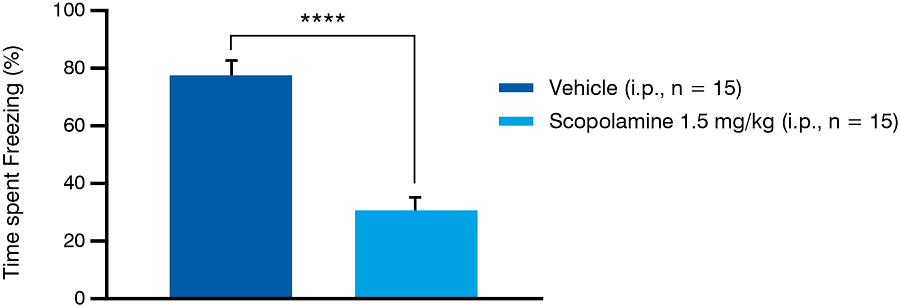
Effect of scopolamine treatment in 8-10 week old B6C mice on performance in contextual fear conditioning, showing decreased time spent freezing following scopolamine treatment when compared to vehicle-treated mice. Data are presented as mean + SEM. **** p < 0.001, Welch’s t-test.
Y Maze (Spontaneous Alternation) Test
The Y maze test is commonly used to assess spatial working memory on rodents. Requiring coordination of multiple brain areas, including the hippocampus, basal forebrain, and prefrontal cortex, spatial memory is often impaired in neurodegenerative disorders such as Alzheimer’s disease and frontotemporal dementia. The Y maze test can be utilized to investigate the effects of novel therapeutics on cognition in models of these disorders.
Rodents have an innate tendency to investigate novel environments over familiar ones, so when presented with a choice of arms to explore in the Y maze test, rodents will alternate between maze arms. Alternation provides a measure of short-term spatial memory, and disease models with compromised cognition will exhibit decreased spontaneous alternation. This test uses a Y-shaped maze enclosure with three arms oriented at a 120° angle. Initially one arm of the maze is blocked, and mice are allowed to explore the remaining two arms. The mouse is then returned to the starting arm and the blocked arm is opened, and alternation between the arms is measured. Results of the Y maze test can be validated with other spatial learning assays, such as the Morris water maze.
Exploratory Toxicology for Neuroscience Drug Discovery
This eBook describes strategies across the early stages of drug discovery to support confidence in your lead small molecule candidate and to ensure you proceed through the drug development process with the most promising candidate.
Download eBook
Morris Water Maze
The Morris water maze is a test of hippocampal-dependent spatial learning and memory and uses a pool with a hidden escape platform and external visual clues. Over the course of repeated learning trials, rodents learn the position of the platform in relation to the external cues. The memory for platform location is tested in probe trials and measured by time spent in the target quadrant that previously contained the platform.
This behavior test is commonly used to assess the effect of therapeutics on cognition in animal models of Alzheimer’s disease, such as the 5xFAD mouse model, or aged rodent models. The Morris water maze is also used to differentiate the effect of drugs across different stages of learning and memory, for example memory encoding, consolidation, and retrieval.
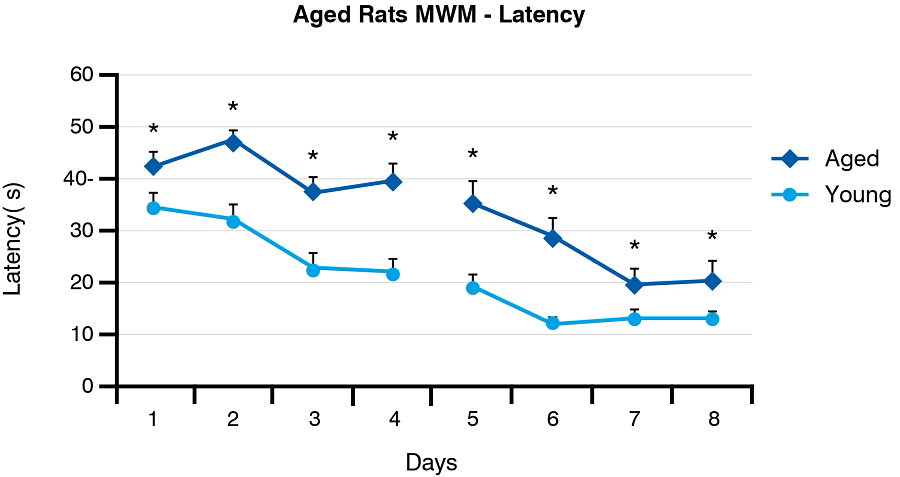
Performance of aged rats in the Morris water maze, showing increase latency to find the platform compared to young rats. Young rats, n = 18; aged rats, n = 14, * p < 0.05, t-test.