
Avoid the Target Deconvolution Bottleneck
Retrogenix® Cell Microarray Technology is ideally suited for target deconvolution. Specifically, it is used to identify the primary targets of large or small molecules that display a desired biological or clinical effect. This ranges from uncovering the primary target of antibodies or small molecule compounds identified by phenotypic screening, right through to marketed drugs where the mechanism of action has not been fully elucidated.
Given that antibody targets are predominantly plasma membrane proteins, and that antibodies require no direct labeling, our technology is used extensively for antibody target deconvolution.
Utilize Target Deconvolution to Discover:
- Novel, druggable targets
- Receptors targeted by phenotypic molecules (antibodies, ScFvs, Fc-fusion proteins etc.)
- Disease-specific antigens by direct screening of patient plasma samples
- Viability for pregnant patients
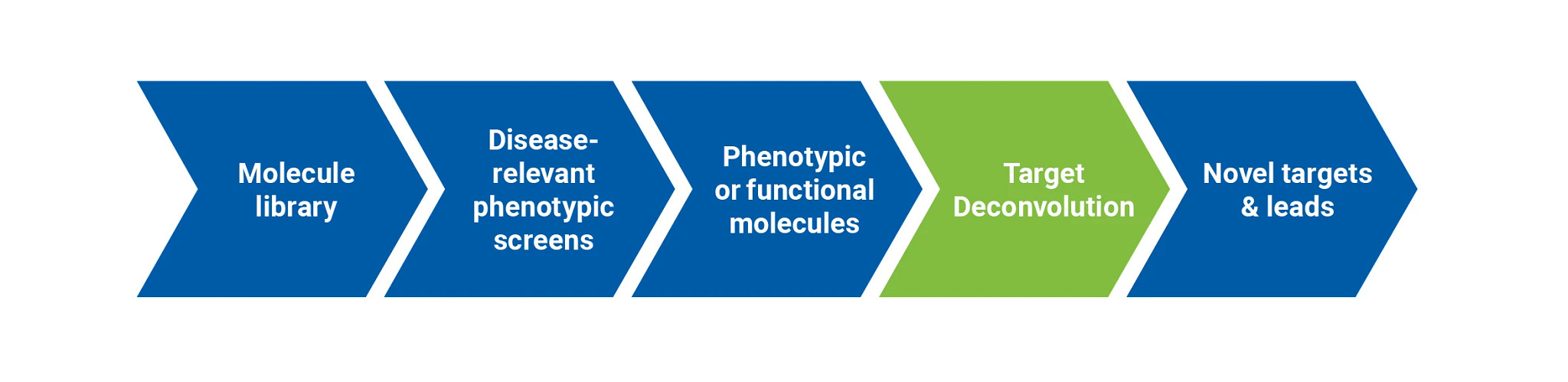
Phenotypic Screening Drug Discovery Process
Unrivalled Success Rates in Target Deconvolution
To date, we have identified specific, reproducible primary target receptors for 60-70% of the phenotypic molecules that have been screened. This includes projects on ‘difficult’ molecules where extensive in-house target deconvolution efforts have failed to find any specific hits or have identified many false positives. This success rate is unmatched by other techniques and is due to our extensive collection of membrane proteins that are expressed in the context of the human cell.
Phenotypic screening is a powerful approach that can identify potential therapies by selecting for disease-relevant binding and/or functional properties of molecules. The nature of phenotypic screening means that any novel targets discovered are likely to be disease-relevant, inherently linked to a desired biological effect, and druggable. Although, knowledge of the target receptor is not necessary for the development of a successful therapy, it is still fundamental for informing lead optimization and is essential in protecting the valuable intellectual property (IP) around that target.
Target deconvolution using Retrogenix® Cell Microarray Technology typically results in a small number of reproducible hits that are specific to the test molecule and generally represent the primary receptor target and its different isoforms.

WEBINAR: Maximize Safer, Targeted Biologic Development with Smarter NAMs-Based Off-Target Screening
This webinar showcases how the Retrogenix® platform empowers smarter, earlier decisions across biologic formats. You’ll also learn how this platform, recently accepted into the FDA’s ISTAND Pilot Program, aligns with evolving regulatory support for NAMs and the shift toward reduced animal use.
Watch the Replay
High Specificity and Target Deconvolution
We produce a low rate of false positives ensuring that months or even years of research are not wasted chasing dead ends when validating potential target hits. Target deconvolution using our technology typically results in one or two reproducible hits that are specific to the test molecule and generally represent the primary receptor target and its different isoforms.
Scripps Study Uncovers Novel Chronic Lymphocytic Leukemia (CLL) Drug Target
A previously unreported cell surface antigen provides a promising new immunotherapy target to treat patients with CLL. The target, Siglec-6, was identified using the Retrogenix® platform after attempts to uncover the antigen by immunoprecipitation and mass spectrometry proved unsuccessful.

eGuide for Off-Target Screening via the Retrogenix Platform
Download the eguide for all the information you need on how the Retrogenix platform can be leveraged to screen for specificity in vitro against a physiologically relevant human protein library from early-phase discovery onwards, to aid candidate selection, downstream study design, and IND approval.
Download now
Frequently Asked Questions (FAQs) for Target Deconvolution
-
Can I screen against a custom subset of the library?
Typically, we can facilitate screening against a custom subset. If you have a specific set of proteins that you’d like to screen against, please get in contact with our team, and we’d be happy to discuss a custom study design.
-
I have compelling phenotypic screening data. How do I deconvolute the target for it?
We would recommend running a receptor ID study in a bid to identify novel/unknown interactors. We offer various study designs for profiling different test articles to maximize the chance of success.