Strategies to Improve Your Mouse Breeding Research Projects
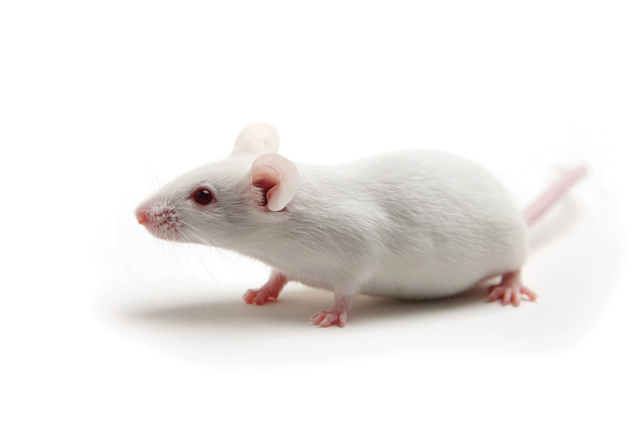
The mouse's reproductive biology is a determining factor in its utility in research. Mice are polyestrous, litter-bearing animals, with a short gestation period. Since they are polyestrous, they will reproduce year-round, and the fact that they are litter-bearing allows for the potential for littermate controls within each litter and quickly engenders many animals for scientific study. The short gestation period means that multiple generations can be produced rapidly and be followed for experimental purposes.
Explore Custom Breeding Services
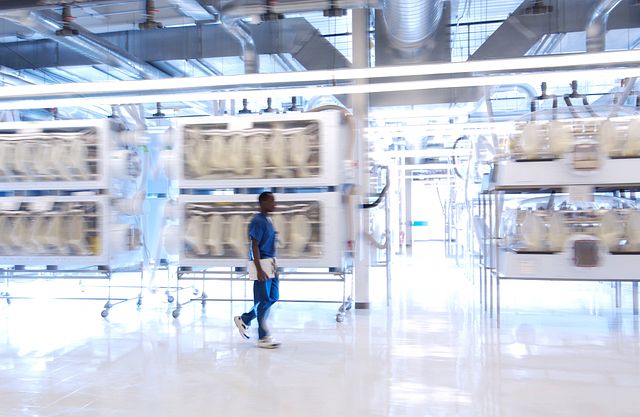
Charles River offers comprehensive rat and mouse colony management, including project management, husbandry, veterinary services, and health monitoring, ensuring study-ready animals are available as needed. Learn More
A further explanation for the mouse's dominance in research is the robustness of its embryos. These may be cryopreserved and cultured from one-cell to post-implantation stages. Tools have been developed that allow for sophisticated manipulations of the mouse’s genome, which allows for the study of the functions of genes within the entire organism. Genes in mice have been removed, replaced, duplicated, and mutated.
Breeding
There are many things that can go wrong during the long, complicated process of getting an animal from a fetus to an age suitable for experiments. In general, however, domestic mice in the laboratory have been selected for their ability and willingness to breed in captivity.
They breed in spite of what we do, not because of it.
Mice Breeding Behaviors
The courtship and mating behavior of mice and rats, essential for successful mice breeding, generally follows a consistent pattern. There is a distinct sequence of approach by the male, acceptance by the female, mating, ejaculation, and a refractory period. Males generally investigate females by sniffing their genitals. If females are not receptive, they avoid contact with males, and if mounting is attempted, they may assume defensive postures.
Length of Gestation
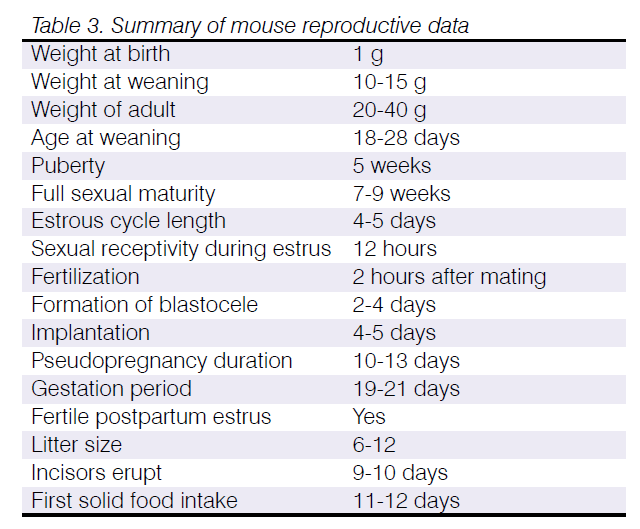
Gestation length is controlled by both genetic and environmental factors. For example, due to the phenomenon of embryonic diapause, the gestation period may appear to be as long as 34 – 38 days. However, it is generally 18 – 21 days for mice.
Parturition
Parturition occurs when the fetuses indicate their readiness. Corticosteroid hormones secreted by the placenta induce luteolysis and begin the parturition sequence. The female exhibits nesting behavior before parturition, and the nests built at that time are complex and differ from nests built at other times. Parturition usually occurs at night for mice. Parturition takes place over a variable span of time, with a pup being delivered every few minutes and the entire litter delivered over the course of 1 – 3.5 hours.
Mating Schemes
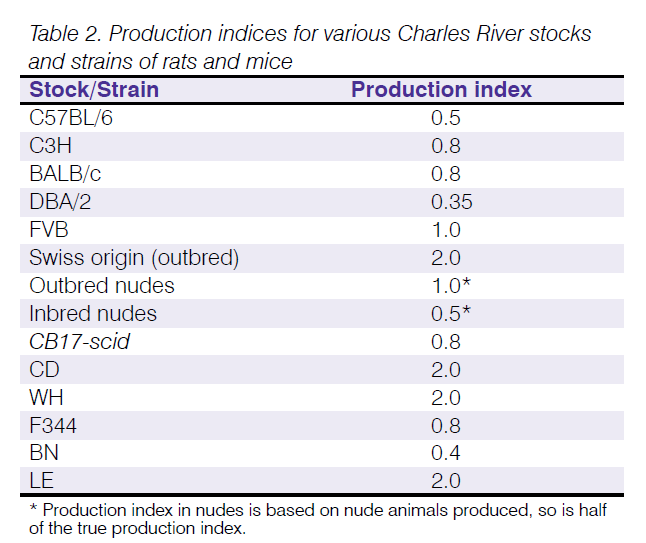
The overall reproductive performance of mice varies widely and is highly dependent on genetic background, with outbred animals generally being more fecund than inbred.
Mice Mating
There are many possible mating schemes for mice breeding, particularly when working with genetically modified rodents. Not all schemes can be used for the maintenance and propagation of animals carrying a particular genetic modification. Any mating scheme should take into consideration the genotypes of the breeders so that the offspring have the desired genotype. This is especially important if a phenotype of interest is expressed only in homozygotes or if expression is sex-dependent. Therefore, having a strong foundation in genetics can be helpful when managing mice breeding colonies.
Two Homozygotes
Breeding two homozygotes will yield 100% homozygous offspring and is useful if the gene effect is seen only in homozygotes and if homozygotes are viable and fertile. Although there will be no sibling control animals, inbred animals of the same strain may be used if the mutants are on an inbred background.
A Homozygote and a Heterozygot
Mating of a homozygote with a heterozygote will yield 50% homozygotes and 50% heterozygotes. This scheme is useful when the phenotype is seen only in homozygotes, and when littermate controls are required. This mating scheme may also be chosen when one sex of homozygotes is not viable or fertile. Mating two heterozygotes will produce 25% homozygote, 50% heterozygote, and 25% wild-type offspring. Use this mating scheme when homozygotes show the desired phenotype but are not fertile.
If heterozygotes are of interest for a phenotype intermediate between wild-types and homozygotes, this mating scheme will often be in use. Mating of a wild-type and a heterozygote yields 50% wild-type and 50% heterozygous offspring. Use this mating scheme for animals with sex-linked mutations.
When expected percentages of genotypes are given, it is likely that genotypes will appear in this ratio in offspring produced over time. It is not a guarantee that every litter will have a particular combination.
Colony Planning
Knowing the goals for the breeding colony in terms of number of animals needed and their characteristics aids greatly in colony size and construction. Given ideal conditions, mice can produce at least four generations in a year.
Production Planning
Colony management starts with production planning; thus, it is important to understand both the purpose and the goals of the mice breeding colonies. A colony whose purpose is to supply females for embryo or blastocyst harvest will be constituted differently from one designed to supply small- or large-scale production for specific experiments, or to serve as a back-up colony as part of disaster planning.
Knowing the goals for the mouse breeding colony in terms of the number of animals that must be produced over a specific period of time and the characteristics of the animals needed, such as sex, age range, and genotype, also aids in colony size and construction.
Meeting Production Expectations
When calculating animal numbers for mouse breeding colonies, consider all the genotypes available, if necessary, as well as the size of key functional groups necessary to produce the required animals, including donor/recipient females, stud/dud males, breeders/future breeders, and stock (experiment) animals.
Historic information regarding the reproductive characteristics of different basic strains and stocks is readily available. These data should be considered starting points when working with animals of various backgrounds. Normal data also change through time due to changes in health status, genetic drift, and environmental factors. Ideally, data collected from the actual colony will allow for accurate calculation of the reproductive performance of particular stocks or strains.

Our colony management and breeding services teams provide breeding plans customized to your needs and can deliver cohorts of study-ready animals on your schedule.
Colony Maintenance
All who work with animals should receive training on how to recognize normal and abnormal rodent behavior and appearance.
Attention Required
Mouse colony maintenance requires rigorous attention to guidelines, regulations, and best practices to ensure effective mouse breeding. Even a seemingly minor misstep, such as a tagging mistake or a misplaced cage card, can have a negative effect on the integrity of your colony.
Performing regular clinical observations on colony animals is crucial to effective colony management, especially when managing genetically altered animals and characterizing novel animal models. Since genetic manipulations can sometimes lead to unpredictable outcomes (i.e., unexpected phenotypes), documentation of specific clinical signs followed by proper diagnostic workup on principal and sentinel animals (if present), pathologic assessments, and elective phenotyping assays should be performed to determine whether specific clinical signs observed are related to animal health status, animal genetic background, or phenotypes resulting from genetic modification.
Recognize Clinical Signs of Trouble
All animal users should receive training on how to recognize normal and abnormal rodent behavior and appearance. They are also encouraged to spend time in animal rooms to gain a better appreciation of normal rodent appearance, behavior, and mouse breeding strategies. In addition to clinical signs recognition training, a reporting system for abnormal findings should be in place.
Timely reporting of clinical signs or colony performance-related problems, such as an increase in mortality, a decrease in frequency of expected genotypes, or a decrease in production, should be made to both the veterinary and investigator groups to initiate diagnostic workups and troubleshooting exercises.
Please refer to the Charles River Handbook on Clinical Observations of Rodents and Rabbits as a training tool for performing clinical observations and for examples of clinical signs that may occur in a rodent colony.
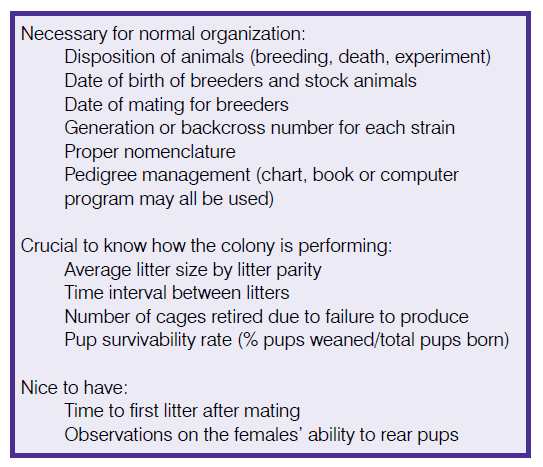
The following indices should be recorded as part of normal colony maintenance operations:
Data Management
Keeping organized breeding records is vital to the success of colony management. Check breeding cages at least once per week for pup birth and breeder reproductive health. Basic breeding information can be tracked at the cage side, and collected information is often transferred into an electronic database as part of laboratory record maintenance.
The database can also be used to calculate and track specific reproductive parameters, facilitate production performance evaluation, and identify problems or corrective measures during troubleshooting exercises. Failure to organize colony data could result in genetic contamination of the colony, a decrease in production, difficulty locating specific animals, or delays in experiments. It is often best to have multiple places to find and cross-reference colony information.
Complete colony records, crucial for mice breeding management, should also include genotyping data. Colony information management solutions range from a simple notebook to exhaustive electronic database systems.
Our Internet Colony Management (ICM™) platform offers 24/7 remote access to your animal colonies, so you can track their progress from anywhere in the world.
Troubleshooting
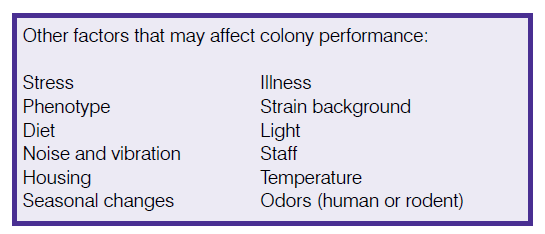
Breeding rodents for research use can be a challenging process with many pitfalls. Environment, genetics, and husbandry can all affect breeding and colony performance.
Where to Start
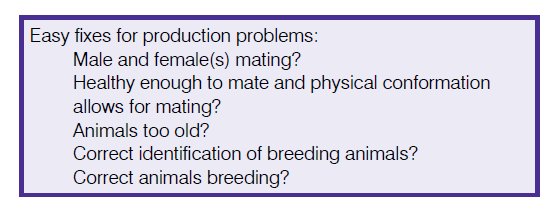
The first step in defining, investigating, and solving the problem of mouse breeding is to review the breeding records. Breeding and production records must be organized and complete, with sufficient details recorded so that analysis of these data can be performed.
After the problem has been identified, the next step is to examine potential solutions. Solutions should be thoroughly discussed and documented to enable recognition of which remedy was pivotal in solving a production-related problem. If animals are challenging breeders, documentation of their special needs should accompany them if they are shared with other investigators.
The first step should be retaining older breeding pairs but also establishing as many new pairs as possible. If possible, introducing new breeding stock, such as young, breeding-age inbred females to established breeder males, may also help.
During all of these efforts, it is advised to monitor breeders and check the females daily, first thing in the morning, for plugs that would indicate successful breeding overnight. Daily checks should be conducted in the lowest-stress manner possible, including, perhaps, the provision of a small food treat as a positive reward. If necessary, a timed breeding paradigm can be used, but recognize that effort, time, and skill are required to accomplish this successfully.
If the problem is related to maternal care, pup fostering should be considered.
For more information and best practices on effective rat and mice breeding, you can download our educational guidebook.
Guidebook on Mouse and Rat Colony Management
This book provides information on managing mouse and rat colonies, colony management from a genetics and reproductive standpoint, and guidance for troubleshooting colony performance. Learn More
