
In Vitro Micronucleus Test
The mammalian cell in vitro micronucleus test (MNT) is used to determine if a compound is genotoxic to cells in culture by evaluating the presence of micronuclei. The test can be performed in primary human peripheral blood lymphocytes (HPBLs) or established cell lines, such as Chinese hamster ovary (CHO) or TK6 cells.
Successfully Navigate Genetic Toxicology Testing Requirements
In this webinar, our experts share thoughts on testing strategies and approaches to address adverse genetic toxicology results. Watch to broaden your understanding of genetic toxicology testing so you can bring your drug to market safely, swiftly, and effectively.
Watch the Webinar
In Vitro Micronucleus Assay Protocol
- Cultures are incubated with several concentrations of the test compound for three to four hours in the presence and absence of metabolic activation (S9) and for 21 to 24 hours in the absence of S9
- A positive outcome is characterized by a statistically significant, dose-dependent increase in micronucleated cells that exceeds historical negative control limits
When to Perform the In Vitro Micronucleus Assay
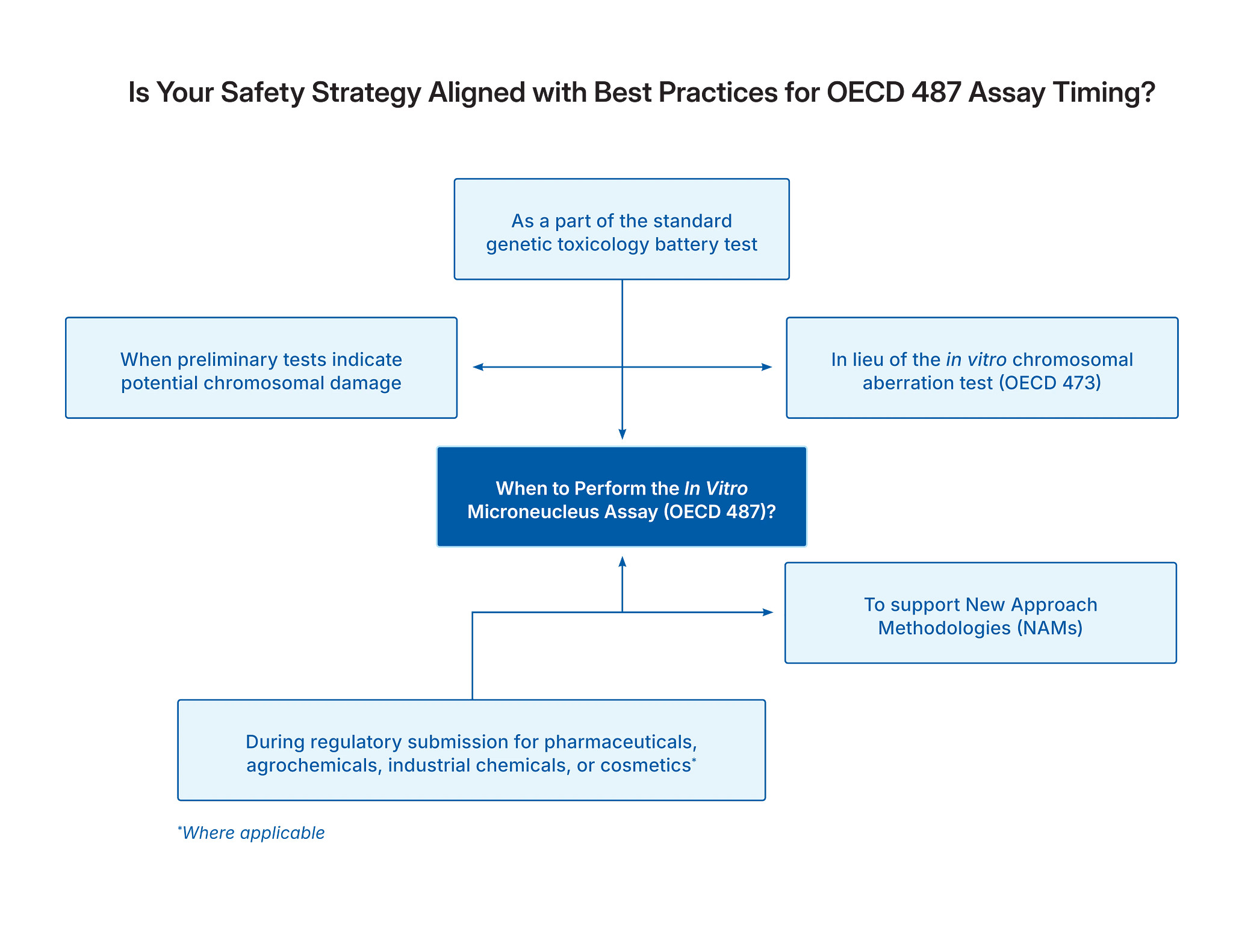
As part of a standard genetic toxicology battery
Typically, alongside:
- OECD 471 (Bacterial Reverse Mutation Test)
- OECD 490 (In Vitro Gene Mutation in Mammalian Cells)
- IND-enabling
- Required by ICH S2(R1) and ICH M7(R1) for pharmaceuticals to assess genotoxic potential
- REACH requirement
- As part of Annex VIII testing
- When preliminary tests indicate potential chromosomal damage. If results from initial screens (like Ames test) suggest potential genotoxicity, OECD 487 can be used to further explore structural and numerical chromosome damage.
- In lieu of the traditional in vitro chromosomal aberration test (OECD 473). OECD 487 is often preferred due to its ability to detect both clastogens and aneugens, offering more mechanistic insight and better reproducibility.
- To support New Approach Methodologies (NAMs) as an animal-free alternative, OECD 487 fits within NAM-based regulatory frameworks for nonclinical safety testing, especially in early discovery or for non-pharmaceutical chemicals.
- During regulatory submission for pharmaceuticals, agrochemicals, industrial chemicals, or cosmetics (where applicable). Used globally in submissions to FDA, EMA, Health Canada, EPA, ECHA/REACH, and others.
In Vitro Micronucleus Assay OECD Guideline
The Organization for Economic Co-operation and Development (OECD) has developed a guideline for conducting the in vitro micronucleus assay (Test Guideline 487). This guideline provides standardized protocols and criteria for conducting the test and interpreting the results.
The OECD in vitro micronucleus assay protocol specifies the following:
- Cell types: Appropriate cell types for the assay include human lymphocytes, Chinese hamster ovary (CHO) cells, and other established cell lines
- Exposure conditions: The test substance should be administered to the cells for a minimum of three hours to a maximum of 24 hours, depending on the cell type and the substance being tested
- Cytotoxicity testing: The cytotoxicity of the test substance should be evaluated to determine the highest non-cytotoxic concentration to be used in the assay
- Treatment concentrations: At least three concentrations of the test substance should be used, including a negative and a positive control
- Sample preparation: The cells should be harvested and processed to prepare slides for microscopic examination of the micronuclei
- Micronucleus scoring: At least 2000 cells per concentration should be scored for the presence of micronuclei
- Data analysis: The frequency of micronuclei should be calculated and compared to the negative control, and the results should be evaluated for positive genotoxicity
Frequently Asked Questions (FAQs) About In Vitro Micronucleus Assay
-
What is micronucleus?
A micronucleus is a small, additional nucleus that forms outside of the main nucleus in a eukaryotic cell. It is a result of chromosomal fragments or whole chromosomes that are not properly incorporated into the daughter nuclei during cell division. During cell division, the chromosomes replicate and segregate into two daughter nuclei. However, occasionally, some chromosomes or fragments fail to segregate properly and are left behind in the cytoplasm. These fragments or chromosomes can then form a micronucleus, which appears as a small, round or oval-shaped structure outside the main nucleus. Micronuclei can be indicative of chromosomal abnormalities, such as DNA damage, chromosome breakage, or aneuploidy (an abnormal number of chromosomes). The presence of micronuclei can be used as a biomarker to assess the level of genotoxicity or chromosomal damage caused by physical or chemical agents on living cells. Therefore, the in vitro micronucleus assay is commonly used in toxicology and environmental health studies to evaluate the potential health risks associated with exposure to genotoxic agents.
-
How do you test for micronuclei?
Micronuclei can be detected and quantified using a variety of techniques, including microscopy, flow cytometry, and automated image analysis. The most commonly used technique for micronucleus testing is microscopy, which involves the visual examination of stained cell preparations under a microscope.
Here are the general steps for testing micronuclei using microscopy:
- Cell culture: Cells are cultured and treated with the test substance of interest
- Cell harvesting: The cells are harvested and fixed on glass slides
- Staining: The cells are stained with a dye that selectively binds to DNA, such as Giemsa stain
- Microscopic examination: The stained slides are examined under a microscope, and micronuclei are identified as small, round, or oval structures located near the main nucleus
- Scoring: The number of micronuclei in each cell is counted, and the frequency of micronuclei is calculated
The in vitro micronucleus test can be conducted using different cell types, including peripheral blood lymphocytes, bone marrow cells, and cell lines. The assay can also be modified to evaluate different endpoints, such as apoptosis, cell cycle arrest, and DNA damage. The OECD guideline provides detailed in vitro micronucleus assay protocols and criteria for conducting and interpreting the test. -
What is the micronucleus used for?
The in vitro micronucleus assay has several applications, including:
- Toxicology: The assay is commonly used in toxicology studies to evaluate the potential genotoxicity of drugs, chemicals, radiation, and other agents. It can provide valuable information on the potential health risks associated with exposure to these agents and help inform regulatory decisions regarding their safety
- Environmental health: The assay is also used in environmental health studies to evaluate the genotoxicity of environmental contaminants, such as air pollutants, water pollutants, and industrial chemicals
- Cancer research: The assay can be used to investigate the role of chromosomal damage and DNA repair in the development of cancer. It has also been used to evaluate the genotoxicity of anticancer drugs and to assess the potential carcinogenicity of chemicals
- Radiation protection: The assay is used in radiation protection studies to evaluate the potential genotoxic effects of ionizing radiation exposure
-
What does the in vitro micronucleus assay measure?
The in vitro micronucleus assay is commonly used in toxicology and environmental health studies to evaluate the genotoxicity of drugs, chemicals, radiation, and other agents. It can be performed on a variety of cell types, including blood cells, skin cells, and buccal cells (cells from the inner lining of the mouth).
The assay can provide valuable information on the potential health risks associated with exposure to genotoxic agents and help inform regulatory decisions regarding the safety of chemicals and other substances.
-
How can the in vitro micronucleus assay complement other genotoxicity assays?
The micronucleus assay can complement other genotoxicity assays by providing additional information on the potential genotoxic effects of a test substance. Here are some ways in which the in vitro micronucleustest can complement other genotoxicity assays:
- Complementary endpoints: Different genotoxicity assays measure different endpoints, such as DNA damage, chromosomal aberrations, and mutations. The in vitro micronucleus test measures the frequency of micronuclei, which can be indicative of chromosomal damage or aneuploidy. By measuring a different endpoint, the micronucleus assay can provide additional information on the potential genotoxic effects of a test substance
- Additional sensitivity: The micronucleus assay can be more sensitive than other genotoxicity assays in detecting chromosomal damage caused by some physical or chemical agents. For example, some substances may cause chromosomal damage that is not detectable by other assays but is visible as micronuclei in the micronucleus assay
- Cell type specificity: The micronucleus assay can be conducted using different cell types, such as peripheral blood lymphocytes, bone marrow cells, or established cell lines. Different cell types may have different sensitivities to genotoxic agents, and therefore, conducting the micronucleus assay in multiple cell types can provide additional information on the potential genotoxic effects of a test substance
- Mechanistic insights: The in vitro micronucleus test can provide mechanistic insights into the genotoxic effects of a test substance. For example, the formation of micronuclei can indicate chromosomal breakage, chromosome loss, or spindle disruption during cell division. By providing information on the mechanisms underlying chromosomal damage, the micronucleus assay can help identify the potential health risks associated with exposure to a genotoxic agent
-
What is OECD Test Guideline 487, and why is it important?
OECD Test Guideline 487 outlines the procedures for the In Vitro Mammalian Cell Micronucleus Test (MNvit), which detects chromosomal damage caused by substances. This assay is a key component of genetic toxicology testing and is often used to support regulatory submissions for pharmaceuticals, chemicals, and consumer products. You can review the full details in the official OECD 487 guideline.
-
When is OECD 487 required in regulatory submissions?
OECD 487 is typically required when evaluating genotoxic potential as part of a regulatory submission for new drugs or chemicals. It is often used alongside other tests like OECD 471 and OECD 490 to form a complete genetic tox battery, especially for ICH M7 compliance. For more information, see the ICH M7(R1) Guideline on assessing mutagenic impurities.
-
What cell lines are commonly used in OECD 487 studies?
Common cell lines include human lymphocytes, TK6 cells, and CHO cells, each offering advantages depending on the context. The choice must align with the recommendations in the OECD guideline and the intended regulatory use. Learn more in the OECD TG 487 summary on cell lines and test systems.
-
How does OECD 487 support New Approach Methodologies (NAMs)?
OECD 487 is an in vitro assay and aligns well with global efforts to reduce animal use in safety testing. It supports New Approach Methodologies (NAMs) by providing mechanistic data relevant to genotoxicity and carcinogenicity risk assessments. Explore how this fits into broader efforts in the EPA NAMs Work Plan on reducing vertebrate animal use.