
In Vitro Dermal Absorption Studies
Our team works with you to design and conduct in vitro skin penetration studies in compliance with both the OECD Test Guideline 428 and with the accompanying Guidance Document No.28. Any relevant industry documents are also taken into consideration. Studies that require Good Laboratory Practice (GLP) compliance enlist the help of our quality assurance team, who will perform audits to ensure compliance.
We perform in vitro dermal absorption studies using either static (Franz-type) cells or our custom-made McGregor/Toner (dynamic flow-through) cells. Radiolabeled test items ([14C] and [3H]) are routinely used in our in vitro skin penetration studies, but we also conduct non-radiolabeled studies where our bioanalytical team can perform various assays ranging from research-grade to full GLP and FDA submission.
Human skin is obtained from elective plastic surgery with Ethics Committee approval and fully informed patient consent. Animal skin, including that from livestock, laboratory, or domestic species, can also be evaluated using these methods. These data can be compared with human data for risk assessment or between-species comparison requirements and utilized to design dermal ADME/toxicology studies.
WEBINAR: Unlock Faster, Smarter Toxicology Decisions
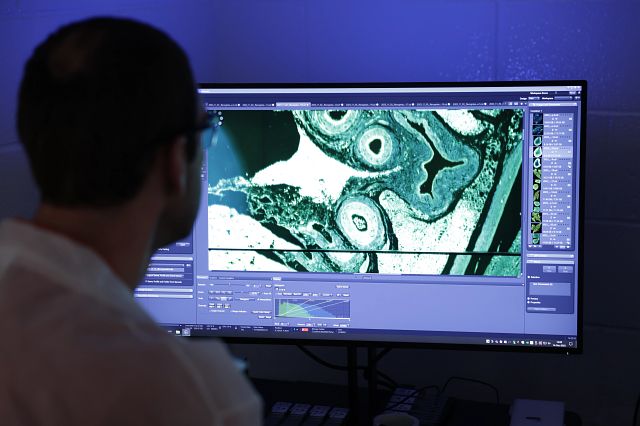
Learn how real-time toxicology data and digital pathology drive accelerated decision-making and reduce costly delays.
Watch the Webinar
Agrochemical/Chemical and Dermal Penetration
- Study design: EFSA/SANCO – concentrate, highest and lowest in-use dilutions
- OECD Summaries
- Triple packs (in vitro and in vivo at the same time)
- Tiered approach (in vitro first, then in vivo)
- Analysis – ICP-OES (for metal analysis), radiolabelled, LC-MS/MS, GC
Pharmaceuticals
- Formulation types – creams, gels, ointments, suspensions, foam, patches, aqueous, solvent
- Analysis type – radiolabelled, LC-MS/MS, GC
Formulation Screening
- In vitro skin penetration studies assist with lead candidate selection (narrowing down formulations)
- RGA1-3 assays
- Utilizes OECD 428 and 28 Guidance Documents

In Vitro Dermal Penetration Services
Charles River scientists have been conducting in vitro skin penetration studies since the 1980s. Learn more about how our expertise has been at the forefront of dermal penetration testing and novel innovation in the field.
Download the PDF
Dermal Penetration Bioequivalence
- In vitro skin penetration studies determine if your product has the same degree of dermal absorption as reference material.
- Full mass balance
- Statistical analysis to show if there is equivalence.
- Follow Acyclovir guidelines
In Vitro Skin Penetration in Consumer Products
- In vitro skin penetration studies are part of a test item’s safety assessment.
- SCCS Guidance Documents 10th Revision
- Formulation types – hair dyes/shampoo/foundation/moisturiser/cleansers/soaps/sunscreen etc.
- Analysis type – radiolabelled, LC-MS/MS
Frequently Asked Questions (FAQs) about Skin Penetration Studies
-
What is In Vitro Dermal Absorption?
In vitro dermal absorption is a test which provides information on the behavior of a test substance, when it is applied to the surface of the skin. The skin sample is placed between two chambers (a donor chamber and a receptor chamber) of a diffusion cell which may be either a static or flow-through set up.