Medical Devices Biocompatibility Testing
The diversity of formats and materials from which medical devices are developed can make it challenging to design tests that adequately assess their safety and efficacy. From polymers, metals, ceramic, biodegradable, and novel materials to an array of solid and porous scaffolds, creams, gels, liquids, fabrics, cements, coatings and surface treatments, we’ve seen it all. Whether you require testing of raw plastic materials (USP Class I to VI) or a finished device, our experts can devise an appropriate biocompatibility testing plan, drawing from our comprehensive portfolio of in vitro and in vivo services.
Biocompatibility Testing for Medical Devices
-
In vitro cytotoxicity (GLP, ISO 10993-5)
Cytotoxicity in vitro screening assays are a sensitive method to rapidly assess the biocompatibility of the test material (extract) when in contact with a specific cell culture. The qualitative version with L929 cells complies with both ISO10993-5 and USP (paragraph 87).
The neutral red uptake (NRU), (ISO 10993-5:2009 (E)), is an in vitro assay designed to evaluate the cytotoxic potential of medical devices using mouse fibroblast BALB/c 3T3 cells. Toxic substances can modify the cell surface or the lysosomal membrane, causing lysosomal fragility and other adverse changes that gradually become irreversible. Such adverse changes cause inhibition of cell growth and/or cell death, which will decrease the amount of NR retained by the culture.
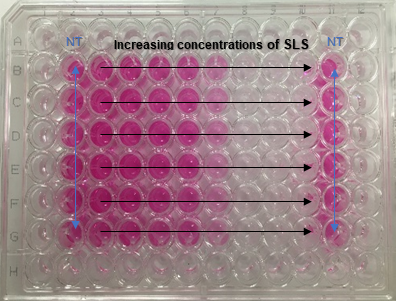
Figure 1: Example of a 96-well plate of a positive control (sodium dodecyl sulfate) used in the Neutral Red Uptake assay (NRU). NT= Non-treated (Blue). Since viable cells retain the NR, the intensity of the colored wells (pink) is directly associated to high cell viability.
-
Sensitization (GLP, ISO 10993-10)
Sensitization biocompatibility testing for medical devices is used to determine the allergic or sensitizing capacity to the repeated or prolonged exposure of a test material. Sensitization is characterized by delayed reactions that are not localized, independent of dose.
- Local lymph node assay (LLNA)
- Guinea pig maximization test (GPMT)
-
Irritation or intracutaneous reactivity (GLP, ISO 10993-10)
Irritation biocompatibility testing consists of in vivo screens that evaluate the potential of test materials – or their extracts – to cause irritation on the exposed part of the body. Standard studies are single-exposure evaluations. Based on clinical product use, studies may be customized for evaluation of repeat exposures.
- Topical irritation (skin, buccal cavity, vagina, urethra, rectum)
- Intracutaneous reactivity: Single or cumulative exposure in accordance with the intended clinical use
-
Pyrogenicity study in rabbits (GLP, ISO 10993-11)
Bacterial endotoxin testing or rabbit material-mediated pyrogen testing detects endotoxin on the biomaterial surface and any related pyrogen reaction via endotoxin contamination with a known specified toxin limit.
-
Genotoxicity (GLP, ISO 10993-3)
Genetic toxicology biocompatibility testing for medical devices evaluates the potential of the test article to induce gene mutations or chromosome damage using a battery of bacterial, mammalian cells in vitro, and in vivo test systems. This critical information constitutes an essential part of preclinical studies because genetic damage can cause an increase in the incidence of heritable diseases and cancer in human populations. Physical or chemical agents that induce such effects by interacting with genetic material and altering their structure are considered genotoxic.
Charles River uses the polar and non-polar extracts methodology. The obtained test samples treat the test systems in the following assays, as per OECD guidelines modified for medical devices, and performed under GLP conditions.
Genotoxicity biocompatibility testing for medical devices:
-
Systemic toxicity
In vivo systemic tests evaluate the impairment or activation of a system – rather than the impairment of individual cells or organs. Acute systemic toxicity tests evaluate the test article material for systemic toxic effects as a result of a single, acute exposure.
- Acute and repeated exposure, available with a wide range of dose routes in appropriate species
-
Hemocompatibility
For devices in direct contact with circulating blood (regardless of contact duration), hemolysis, complement activation, and thrombogenicity biocompatibility testing may be performed. Hemocompatibility tests are more commonly used to evaluate the effects of blood-contacting medical devices. Hemolysis determines the degree of erythrocyte (red blood cell) lysis and the release of hemoglobin caused by medical devices in vitro. Both direct (implantation) and indirect (extract) methods for material/surface-mediated hemolysis may be conducted. Charles River offers two in vitro hemocompatibility tests:
- In vitro hemolysis
- In vitro coagulation
-
Carcinogenicity and reproductive toxicity
Carcinogenicity and reproductive toxicity testing is rarely required for medical devices. However, when necessary, Charles River’s capabilities and experience with carcinogenicity testing of pharmaceuticals enables us to offer this service to medical device developers when necessary.
With preclinical sites in Europe and North America, discover how Charles River can support your biocompatibility testing program:
Have a question about your medical device biocompatibility testing?
Frequently Asked Questions (FAQs) for Biocompatibility Testing
-
Why do I need to perform medical device biocompatibility testing?
Biocompatibility testing for medical devices is a regulatory safety requirement that ensures that a device is compatible with the biologic system where it will be implanted or used.
-
What are the regulatory requirements for biocompatibility testing?
The US FDA, TGA, and Regulatory Bodies in Europe follow several regulations. Europe and Asia follow the ISO 10993 as the main source for guidance of the testing protocols. The US FDA has adopted some of the ISO 10993 guidelines, but for some testing it follows the USP, ASTM and US FDA “Blue Book.”
-
What are the tests I need to perform for my device?
The gold standard for biocompatibility testing is to perform a device chemical characterization followed by a TRA (toxicological risk assessment). For more insight, please review our Biocompatibility Evaluation of Orthopedic Biomaterials and Medical Devices: A Review of Safety and Efficacy Models.
-
Does the lab I choose need to follow the GLP requirement for the biocompatibility testing?
To support global submissions, all their protocols must be compliant with OECD GLPs in addition to US FDA GLPs. In addition, laboratories that offer medical device biocompatibility testing are widely expected to have ISO/IEC 17025 accreditation.
Optimizing Viral Clearance Studies for Medical Devices: Challenges, Expectations, Examples
In this webinar, our experts provide key strategies you can apply to your own medical device viral clearance program, including study guidelines, the types of materials and model viruses used, and methods for performing viral clearance testing on solid materials.
Watch the Webinar