Huntington’s disease drug discovery
To support Huntington’s disease drug discovery, we offer a comprehensive portfolio of validated in vitro Huntington’s disease assays, using primary cell lines, patient-derived cells, commercially available cells, and human post-mortem tissues. In collaboration with CHDI, we have developed and validated assays to screen small molecules, including our in-house compound libraries, and RNA therapies, including commercial siRNA libraries. These assays are designed to evaluate the ability of your therapy to regulate mutant HTT (mHTT) and potentially reverse disease phenotypes, such as somatic instability and mHTT aggregation.. Below you will find an outline of our available cells and assay readouts, along with example data for in vitro Huntington’s disease assays.
In Vitro Huntington’s Disease Models:
- Overexpression of mutated human HTT in SH-SY5Y cells
- In-house differentiation of striatal and cortical neurons from patient-derived stem cells, with a range of CAG repeats
- Patient-derived fibroblasts and lymphoblasts
- Bit.bio’s iPSC-derived ioGlutamatergic Neurons HTT 50CAG/WT
- Ex vivo mouse brain slices (striatum)
- Other commercially available Huntington’s disease cell lines
In Vitro Huntington’s Disease Assays:
- HTT detection assays for endogenous or induced HTT expression, aggregated HTT, soluble HTT and polyQ-independent HTT (MSD, SMCxPro, Quanterix, and TR-FRET)
- High-throughput screening to identify compounds that lower mHTT (HTRF assay in 384-well format)
- HTT selectivity assays
- Cell survival and toxicity assays
- Multi-electrode array electrophysiology to determine functional phenotype changes
- Manual patch clamp of mEPSCs in medium spiny neurons in adult mouse striatum acute slices to assess compound efficacy

Human Stem Cell Derived Huntington’s Disease Model
Presented at SfN 2023, this poster describes the validation of a human iPSC-derived neuronal model and its use to screen small molecule modulators of mutant HTT.
View the Poster
Example In Vitro Huntington’s Disease Studies
Screening small molecules for HTT-lowing ability
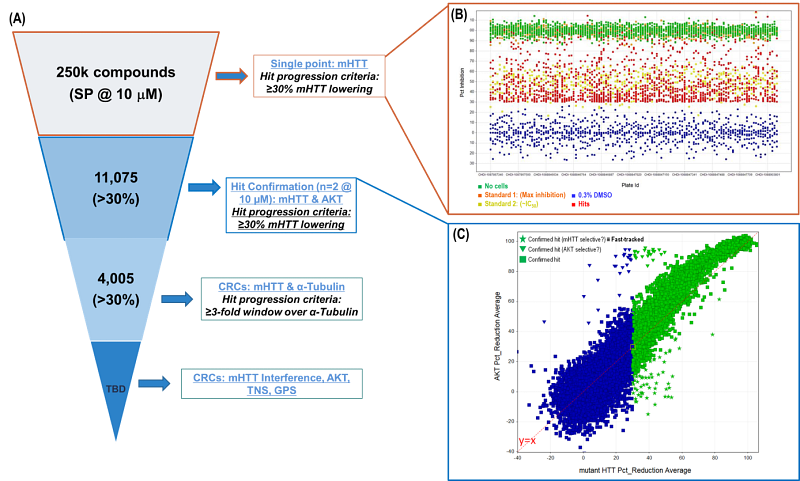
High-throughput screening services and compound libraries enable the rapid identification of small molecules with the potential to lower mHTT and treat Huntington’s disease. In the example screening cascade below, an initial population of 250,000 small molecules was screened for their mHTT-lowering ability in the GENEA020 human embryonic stem cell (hESC) line, using greater than 30% mHTT-lowering as a cutoff. 11,075 compounds were then assessed for their selectivity to HTT compared to AKT, with 58-HTT-selective compounds fast-tracked for further assessment.
Functional network changes in Huntington’s disease stem cell model
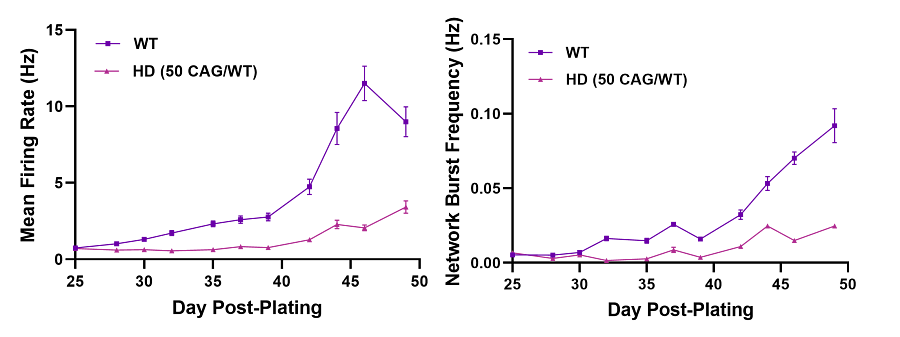
Changes in neuronal network formation and function can be assessed in human iPSC-derived neurons with multi-electrode array (MEA) electrophysiology. ioGlutamatergic Neurons HTT 50CAG/WT™ and isogenic controls (WT) are co-cultured with Fujifilm astrocytes, forming networks with synchronous activity. From around 40 days post-plating, Huntington’s disease cells display reduced excitability, determined by mean firing rate and network burst frequency. This assay can be used to screen lead compounds for efficacy against functional Huntington’s disease phenotype changes.