
Open Field Test (Spontaneous Locomotor Activity)
Open field test is commonly used to investigate general locomotor activity, including hyperactivity or fatigue in rodents, and is often used in animal models of Alzheimer’s disease, Huntington’s disease, Parkinson’s disease, and rare neurological disorders. Additionally, open field test can also be used to examine anxiety-like behaviors in rodent models to study mental disorders.
Open Field Test Protocol and Data
Open field test is performed in an enclosure divided into a center and peripheral zone. Thigmotaxis, the relative time spend in the periphery versus the center of the area, serves as a measure of anxiety-like behavior. This is due to the natural tendency of wild-type rodents, as a prey species, to prefer to stay in the periphery of an open enclosure. This behavior can also be examined in rodent disease models that may not display the same wild-type behavior. Anxiety-like behaviors should be validated with specific anxiety behavior tests, such as the elevated plus maze. Similarly, changes in locomotion and activity should be validated with specific motor tests.
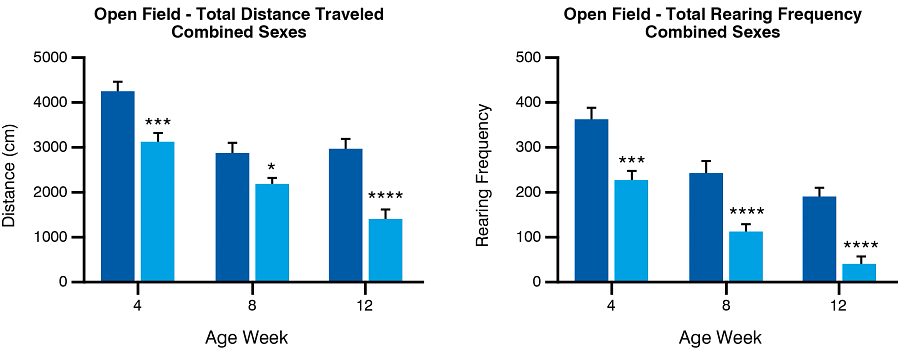
Performance of R6/2 Huntington’s disease mouse model in open field test, showing a decrease in distance traveled and total rearing as pathology develops from 4 to 12 weeks of age. Statistical significances: * p < 0.05, ** p < 0.01, *** p < 0.001, **** p < 0.0001 R6/2 Vehicle vs. WT Vehicle (Mixed-effects model (REML), Uncorrected Fisher's LSD). N=20.
Nest Building Test
Nest building is a natural behavior performed by both male and female rodents. This is an intrinsic activity that requires fine motor skills, and examination of nest building is a simple test to detect motor deficits as well as changes in general health and wellbeing. The nest building test is sensitive to changes in genetic mutations, presence of investigational compounds, and environmental changes.
Nest Building Test Protocol and Data
To examine nest building, nesting material is placed overnight in the home cage of a singly housed rodent. The quality of the nest built is manually rated on a 5-point scale. There are several advantages to using the nest building test to examine rodent behavior:
- Simple test that provides robust readouts
- Bedding material not used can be weighed to give an objective measure of nest building behavior
- Performed in the rodent’s home cage without the presence of an experimenter
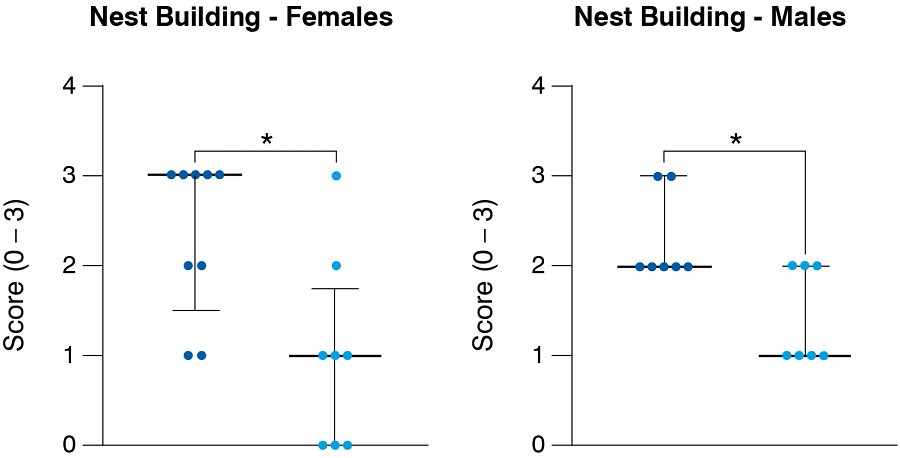
Performance of nine-month-old 5xFAD Alzheimer’s disease mouse model in nest building test, showing a deficit in nest building in female and male mice. Data are presented as mean + SEM. WT (n = 9/7); 5xFAD (n = 8/7); * p < 0.05, Mann-Whitney test.
Fine Kinematic Motor and Gait Analysis
Fine kinematic motor and gait analysis is a highly sensitive and translational automated method to measure changes in motor activity and gait. Compared to conventional motor behavior tests, such as rotarod or grip strength, fine kinematic analysis enables much earlier observation of deficits in animal models of disorders with a motor component, such as ALS, muscular dystrophy, and Parkinson’s disease. Through simultaneous analysis of the complex coordination patterns of multiple joints and body parts, kinematic motor and gait analysis explores changes to limb coordination, limb trajectories, gait spacing, body posture, and joint angles in disease models and for kinematic profiling of pharmacological treatments.