
Cell-Based ALS Assay Models
For ALS research, we can provide a variety of models with recommended disease-relevant endpoints to further your neuroscience drug discovery programs. Some of our most used models are as follows:
- Ready-to-use iPSC-derived cells: Human iPSC-derived cell lines, including motor neurons (with disease-relevant mutations), astrocytes, microglia, and others for use in drug discovery assays, through external partnerships
- Cell Lines and Exogenous Expression Methods: Includes immortalized cell lines and various expression methods, using CRISPR and lentiviral transduction
- Patient-Derived Stem Cells: In-house differentiation capabilities and production of cortical neurons, motor neurons, and others; For example, the differentiated neurons express motor neuron markers including Islet1 and SMI32, and have a similar electrophysiological signature (heterogeneous outward K+ current and fast inactivating inward Na+ currents) as wild-type motor neurons, confirming the structural and functional phenotypes of patient iPSC-derived motor neurons
- Human Post-Mortem Tissue: Access to human post-mortem brain tissue, including paraffin-embedded and frozen brain tissue from ALS patients and controls
Developing ASOs for ALS
In this webinar experts discuss the process of ASO design and screening, and considerations for taking your into in vivo efficacy studies.
Watch the webinar
ALS Readouts in Cell-Based Assays
This physiologically relevant cell system allows high-throughput screening of small molecule libraries or functional genomics-type approaches (RNAi/CRISPR-Cas9), using high-content imaging readouts. Some of the disease-relevant readouts that will be developed for screening include:
- C9orf72 RNA foci formation
- C9orf72 di-peptide aggregation (RAN translation products)
- Stress granule formation
- Nucleo-cytoplasmic transport
- TDP-43, FUS and SOD1 localization and aggregation
- Functional neuronal activity with multielectrode array (MEA) or patch clamp electrophysiology
- Cytotoxicity assays
- Neurite degeneration & outgrowth assays (high-content imaging)
Profiling of ASO Candidates in iPSC-Derived Motor Neurons
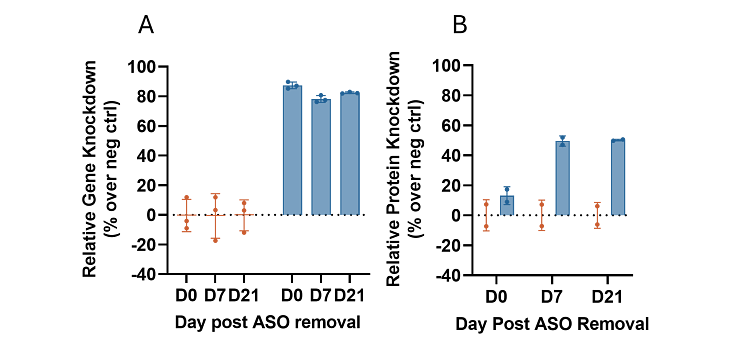
In this study, antisense oligonucleotides (ASOs) were profiled to evaluate their knockdown effects on the target gene. Target mRNA and protein knockdown were investigated by high-throughput screening methods following oligonucleotide treatment of human iPSC-derived motor neurons. The data below show that a single ASO treatment resulted in effective and stable knockdown of gene (A) and protein (B) levels over time.
Neuronal Activity in iPSC-Derived ALS Neurons
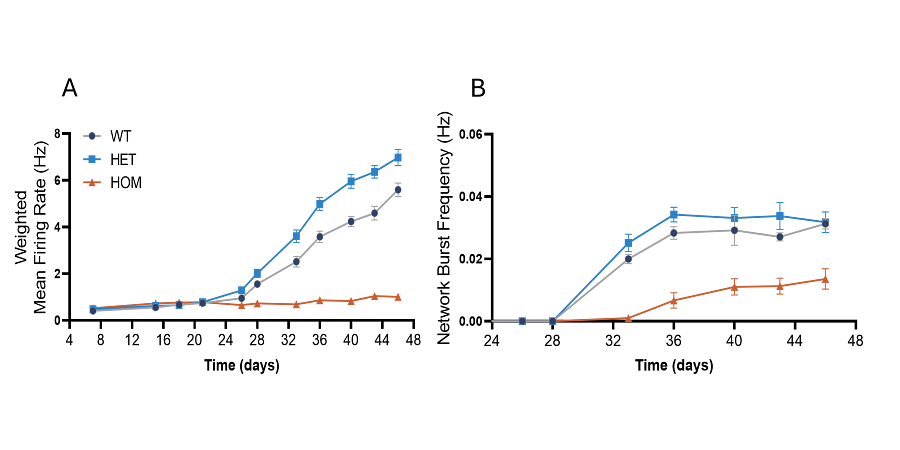
In this example, wild-type ioGlutamatergic neurons, ioGlutamatergic TDP-43 M337V/WT, and ioGlutamatergic TDP-43 M337V/M337V mutant neurons were co-cultured with astrocytes. Both wild-type and ALS neurons with TDP-43 mutations formed networks with synchronous activity in vitro, detected by MEA. There was a significant reduction in excitability metrics, such as mean firing rate (A) and network burst frequency (B), in the homozygous TDP-43 mutant cell line as seen in the data below.
How can we support your program?
Frequently Asked Questions (FAQs) for ALS Assays
-
What is ALS?
Amyotrophic lateral sclerosis (ALS) is a progressive neurodegenerative disease that progressively and irreversibly affects motor movement due to the death of motor neurons in the brain and spinal cord. ALS is characterized by stiff muscles, muscle twitching, and gradually worsening weakness due to muscle atrophy and this results in difficulty speaking, swallowing, and eventually breathing. About 90% of ALS cases have no known etiology while the remaining 10% have a genetic cause. Mutations in over 20 genes have been associated with familial ALS with mutations in 4 genes accounting for the majority of familial cases – SOD1, FUS, TDP-43, and C9orf72.
The disease prevalence is approximately 4-8 per 100,000 people with a median survival rate of 2-4 years. Current treatments are limited to palliative care and supportive treatment and while there are two approved drugs, both show only modest therapeutic effects. Therefore, given the unmet need to develop disease modifying therapies, there are increased efforts to develop novel targets and therapeutic candidates to delay progression and reverse ALS. Charles River is focused on developing robust in vitro assays that utilize patient-derived induced pluripotent stem cells (iPSCs) to set-up physiologically-relevant assays to identify therapeutic compounds. The iPSCs are used in a high-content assay format to identify targets implicated in motor neuron cell death.