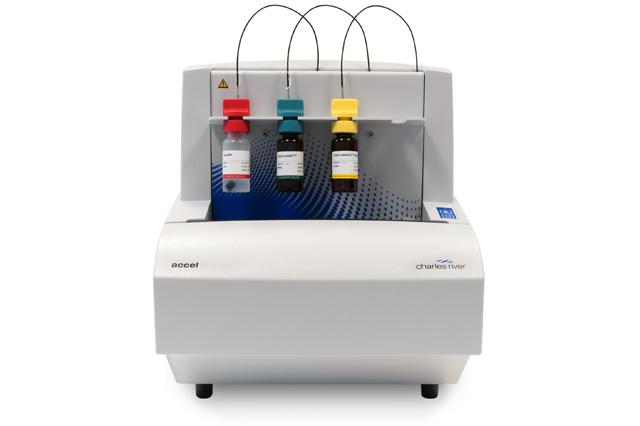
Rapid Microbial Limit and Sterility Test Results for Microbiology Quality Control
Easy to use and easy to learn, the Celsis Accel system delivers results in just 24-36 hours for microbial limits (USP <61>) quality control testing and 6 days for sterility testing (USP <71>), allowing you to rapidly confirm product quality and expedite release to market.
The ability of the Celsis Accel system to confirm the absence of contamination allows your in-house quality system to:
- Shorten production cycle times
- Decrease working capital requirements as well as safety stock
- Reduce inventory requirements and warehouse space costs
- Receive earlier notification in the event of a contamination
- Respond to contamination and conduct investigations faster

Explore the Celsis® Rapid Microbial Detection Brochure
Gain insight into Celsis® technologies, platform capabilities, implementation considerations, validation support, and microbial detection applications across a range of product types.
Access the Brochure
Celsis Accel Product Details and Features
-
Celsis Accel System Features
- Runs up to 30 assays per hour with the option of combining multiple batches or protocols into a single run
- Developed exclusively for small and mid-sized pharmaceutical and home and personal care manufacturing
- Offline incubation maximizes system throughput
- Click to start: enjoy walk-away automation
- Compact, bench-top instrument
-
Accel.im™ Software Features
- A new, secure ‘Remote User Option’ allows monitoring of product quality testing results from multiple locations
- Automated data capture and storage, exporting to common database programs, including Excel and Access
- Design and generate graphs for easy data trending and report generation
- Customizable security levels with one-click lockout
- Fully validated on Microsoft Windows® operating systems
- Allows full compliance with the FDA’s 21 CFR Part 11 and the European Union’s Annex 11
-
Specifications
- Compact footprint:
- 13” x 14.5” x 20.5” (w x h x d)
- 33 cm x 37 cm x 52 cm (w x h x d)
- Weight: 53 lbs / 24 kg
- Electrical Requirements: 100 – 240 Volts, 50 or 60 Hz
- Optional Fourth Injector
- Validated on Microsoft® Windows® XP Professional, Windows® 7 Professional, Windows® 8 Pro, and Windows® 10
Product Code Celsis Accel® System C7460288 - Compact footprint:

Guidance on Implementation of Alternative RMMs
This Ebook addresses the technical, business, and data integrity issues in implementing ARMM technologies for the development, in-process control, and commercial release of drug products.
Access the Ebook
How the Celsis Accel® System Works
The Celsis® assay rapidly confirms the presence or absence of microbial contamination using an amplified ATP-based bioluminescence reaction. Our method preserves your originally validated sample preparation methods, such as bioburden filtration or direct inoculation. Once prepared, the samples are enriched for a period based on your product specification. Once completed, samples require minimal steps before being loaded into the Celsis Accel. Up to four variable-volume reagent injectors ensure accuracy, reduce sample handling and increase flexibility. System throughput runs as high as 30 tests per hour with the option of simultaneously combining multiple batches or protocols into a single run. The user interface of the LIMS-compatible system software objectively interprets and displays results in a color-coded table or graphical view.

Let Us Perform Your RMM Validation
We can perform the necessary validation testing to meet criteria set forth in USP <1223> and Ph. Eur. <5.1.6> on your behalf. Learn how we can reduce your timeline to implementation by more than half with our Celsis® Complete Service or our Celsis® Advantage packages.
Fast Track Your RMM Validation
Frequently Asked Questions (FAQs) About Data Integrity and Rapid Microbiology
-
What is data integrity in microbiology quality control?
Data integrity is a collection of practices that lead to secure reporting, handling, and archiving of quality control testing data generated in the microbiology lab. Data integrity allows laboratories to make sound decisions based on their test data and have confidence that the data is not inadvertently or intentionally manipulated.
-
How do instruments like the Celsis Accel® help with data integrity?
Instruments like the Celsis Accel and the Celsis Advance II lead to better data integrity practices in two ways: by replacing subjective tests involving visual, human-based confirmation of no growth with an automated assay, and by handling the reporting of results via software.
-
What’s the risk of using subjective test methods with data integrity?
With subjective tests such as visual turbidity or visual enumeration of plates that are typically 0 CFU (such as Water for Injection), there is a risk of missing a positive count. In certain production processes, contaminations are so infrequent that analysts do not have experience ever seeing a certain sample come back positive, or maybe become accustomed to samples never being contaminated. Additionally, when transcribing and reporting results, analysts can make transcription errors due to handwriting or mistaken keystrokes.
