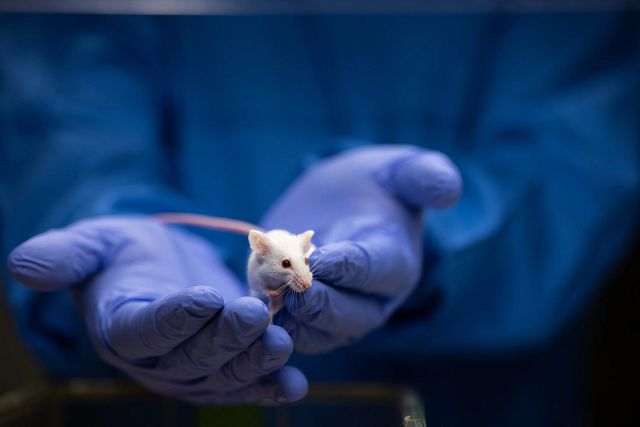
What is Low-Stress Handling?
For mice and rats, low-stress handling primarily refers to the method by which animals are removed from and placed into their holding enclosures, including tunnel or cup/body handling.
Why Employ Low-Stress Handling?
Research has shown that picking up mice by the tail can induce aversion and anxiety, and it should generally be avoided. Instead, mice should be picked up using a non-aversive method that promotes a positive response to human contact. Refined handling, credited with improving welfare and scientific quality:
| ✔ Reduces anxiety | Reduce anxiety and increases volontary interactions with handlers as measured by the elevated plus maze, social novelty test, open field test, and light-dark box test1 |
| ✔ Reduces depressive-like behavior | As measured by sucrose reward, resilience to negative events,2, 3 forced swim test, and burrowing test4 |
| ✔ Reduces chronic stress | As measured by adrenal gland size3 |
| ✔ Increases test reliability | Non-aversive tunnel handling has been shown to improve mouse performance in behavioral tests compared to traditional tail handling.5 |
| ✔ Improves physiological parameters | Such as improving glucose tolerance and reducing blood glucose and corticosterone6, 7 |
| ✔ Improves breeding | As measured by larger pups (0.75g), more pups born (1), weaned (1.5), and longer breeding productive lifespan (20%;)8 |
We Can Improve Animal Welfare Together
Our goal is to have mice and rats of all ages routinely handled using low-stress handling methods in all rooms, all study types, and all departments or sectors across all business units and sites producing, housing, and working with these species. Charles River is proud to have implemented low-stress handling of mice and rats at 93% of our sites.
Resources
-
References
- Hurst JL, West RS. Taming anxiety in laboratory mice. Nat Methods. 2010 Oct;7(10):825-6. doi: 10.1038/nmeth.1500. Epub 2010 Sep 12. PMID: 20835246.
- Clarkson, JM, Dwyer, DM, Flecknell, P.A. et al. Handling method alters the hedonic value of reward in laboratory mice. Sci Rep 8, 2448 (2018).
- Clarkson JM, Leach MC, Flecknell PA, Rowe C. Negative mood affects the expression of negative but not positive emotions in mice. Proc Biol Sci. 2020 Aug 26;287(1933):20201636. doi: 10.1098/rspb.2020.1636. Epub 2020 Aug 26. PMID: 32842924; PMCID: PMC7482280.
- Sensini, F., Inta, D., Palme, R. et al. The impact of handling technique and handling frequency on laboratory mouse welfare is sex-specific. Sci Rep 10, 17281 (2020).
- Gouveia, K., Hurst, J. Optimising reliability of mouse performance in behavioural testing: the major role of non-aversive handling. Sci Rep 7, 44999 (2017).
- Ghosal S, Nunley A, Mahbod P, Lewis AG, Smith EP, Tong J, D'Alessio DA, Herman JP. Mouse handling limits the impact of stress on metabolic endpoints. Physiol Behav. 2015 Oct 15;150:31-7. doi: 10.1016/j.physbeh.2015.06.021. Epub 2015 Jun 13. PMID: 26079207; PMCID: PMC4546855.
- Ono, M. et al. (2016). Does the routine handling affect the phenotype of disease model mice?. The Japanese journal of veterinary research. 64. 265-271. 10.14943/jjvr.64.4.265.
- Hull MA, Reynolds PS, Nunamaker EA (2022) Effects of non-aversive versus tail-lift handling on breeding productivity in a C57BL/6J mouse colony. PLoS ONE 17(1): e0263192.
- Hurst JL, West RS. Taming anxiety in laboratory mice. Nat Methods. 2010 Oct;7(10):825-6. doi: 10.1038/nmeth.1500. Epub 2010 Sep 12. PMID: 20835246.