
Flp and Cre Transfection in Mouse and Rat Zygotes
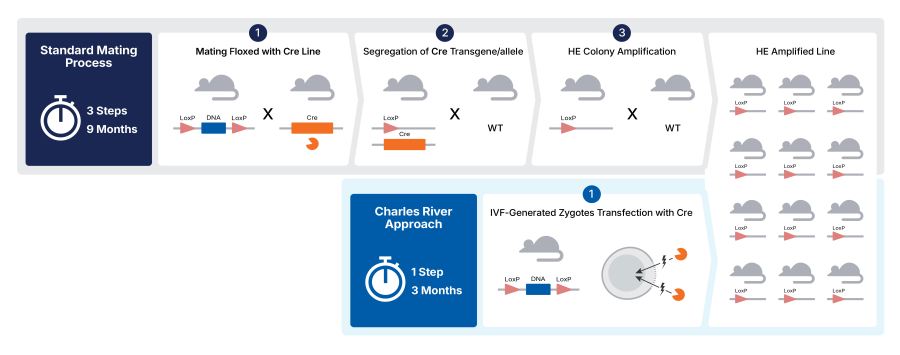
Charles River's innovative approach combining in vitro fertilization and transfection of Flp and Cre recombinases offers many advantages compared to the traditional mating process.
Combining Allele Ubiquitous Cre Recombination and Line Amplification in a Single Step
Advantages of Flp and Cre Recombinase-Mediated Gene Editing In Vitro Approach
| Consideration | Mating Approach | In Vitro Approach |
|---|---|---|
| Timeline for scale-up HO generation | 12 months without backcross Up to 27 months with backcross | 6 months |
| Animal reduction | Requires 4 generations of animals breeding to scaled-up HO colony | Requires only one breeding step to generate the scaled-up HO colony |
| Research model genetic status | When crossing a model with another line, it often leads to genetic background deviation requiring subsequent backcross | Full original genetic background is maintained thus ensuring genetic stability and reproducible experimental data |
| Flp and Cre recombinase-expressing line access | Requires importation of live animals or frozen material + revitalization or maintenance of permanent colonies | Not required |
| Amplification of edited heterozygous line | Can only be performed after gene edition step and elimination of Cre/Flp expressing construct | Performed during same step as gene edition thus saving two breeding generations |
| Flp and Cre recombinase-expressing transgene segregation | One breeding generation with associated genotyping is usually required to eliminate Cre/Flp expressing construct | Not required |
Standard Services
- One-cell embryos generation by in vitro fertilization
- Flp or Cre recombinases transfection into one-cell embryos
- Embryos reimplantation into foster females
- Housing of animals for 10 weeks from birth
- Liberating health control: SOPF status
Applications
- Generation of constitutive knockouts
- Excision of selection or reporter markers such as antibiotic resistance gene, GFP, etc.
- Generation of expressing line starting from conditional expression (excision of STOP transcription cassettes)
Frequently Asked Questions about Flp and Cre Recombinase
-
What are Flp-FRT and Cre-Lox systems?
Recombinant systems such as Flp-FRT and Cre-lox are widely used in genetic engineering to selectively activate or deactivate specific genes within organisms. These systems enable precise control over gene expression, facilitating studies on gene function, the creation of constitutive and conditional knockout models, and the development of tissue-specific genetic modifications.
Additionally, they are used to remove selection markers, such as antibiotic resistance cassettes in mice derived from chimeric males obtained after injection of genetically modified embryonic stem (ES) cells in wild-type host embryos.
Dual recombinase, whereby Flp and Cre systems are used in the same mouse model, may be used by researchers performing complex manipulations necessitating sequential deletions or modifications. Both Flp-FRT and Cre-lox allow for high-fidelity DNA modifications to be induced in vitro or in vivo.
The key difference between the two systems is temperature. The optimal reaction temperature of Cre recombinase is 37°C, the approximate core body temperature of mice. Flp recombinase performs better at lower temperatures; 30°C is optimal.
See also: History of Cre Mice
-
How do Flp and Cre recombinases work and how is Charles River's approach different from the conventional gene editing procedure?
In the conventional method of gene editing in rodents, a transgenic line (line A) that expresses the Flp or the Cre recombinase enzyme is bred with a genetically modified line (line B) where the gene of interest is flanked by Frt or loxP sites. The offspring inherit the Flp or Cre recombinase gene from one parent and the floxed allele from the other parent.
In our procedure, recombination is achieved after the introduction of Flp/Cre protein or mRNA into one-cell embryos of line B by transfection method. It results in the editing of the target allele without importation of genome from line A.
This method not only avoids the need for an additional breeding generation to remove the Flp or Cre transgene, and also the genetic background mix, which can influence mouse model phenotype.
-
Can I generate tissue-specific Flp or Cre recombination with this method?
This is not possible with the described approach, since Flp or Cre recombinase is expressed transitionally in the very early preimplantation embryo. The recombination occurs in the one-cell embryo, ensuring that all subsequent cells derived from it carry the recombination event. By consequence, the recombination is ubiquitous.
-
What will be the health status of the resulting Flp or Cre recombined line?
The resulting mice will demonstrate a Specific Opportunists and Pathogen Free (SOPF) health status, enabling them to be accepted into any animal facility globally. Should the initial floxed mouse line have harbored any pathogens or opportunistic agents, these will be eradicated in the final line, as the transfected zygotes are implanted into SOPF foster females. This entire process is effectively equivalent to a rederivation procedure.
-
What is the efficiency of Flp or Cre excision with your approach?
Following exposure of one-cell embryos to Flp or Cre recombinase, between 95% and 100% of floxed alleles will undergo recombination. This remarkable efficiency enables the simultaneous editing and upscaling of the Flp- or Cre-edited mouse line in a single step, thanks to IVF.
-
Should the floxed mouse line be heterozygous or homozygous?
The floxed mouse line can be either heterozygous or homozygous. It is crucial, however, to verify that the edited allele in its homozygous form is compatible with embryonic development, otherwise, no litter will be obtained.