
Hit Data That Drives Decisions and Investment Confidence
Acquire high-quality hits against even the most challenging targets or phenotypes by working in partnership with our experienced team, taking advantage of our state-of-the-art HTS platform and accessing industry-leading compound libraries comprising over 1.4 million structures.
Providing both molecular target-based and phenotypic screening options, our scientists work in close collaboration with you to deliver either standalone screens or full programs through hit identification and beyond, from inception to qualified and clustered starting points for ongoing drug-discovery activities.
Why choose Charles River to deliver your high-throughput screening (HTS) services?
85% of the drugs approved by the FDA in 2023 were developed with Charles River. Over one hundred candidates have been delivered by our scientists (over a third of which have reached clinical PoC), and over 500 patents name Charles River scientists as co-inventors.
Our experienced scientists have the depth of expertise to turn your ideas into life-changing therapies. Here are just some of the reasons researchers choose to work with our world-class high-throughput screening team:
- Access over 1.4 million rigorously curated compounds – Grouped into 10 core collections, we offer access to a large compound screening library, which is actively and expertly curated and controlled for quality. Researchers may screen their own library, one of our sub-libraries in its entirety, or work with our screening and CADD teams to create a screening set tactically optimized to meet their research objectives.
- Medicinal chemistry-aligned results – To give you the best chance of success as you move downstream from hit identification, your screening team will include a medicinal chemist as standard, and all HTS assays deliver hit matter with the following:
- XC50 curves
- Clustering
- Early SAR insight
Regardless of the high-throughput screening route you choose, you will receive full and open data disclosure, agile assay development, full project management with a single point of contact, and access to experts and capabilities across the discovery continuum to advise on de-risking and next steps.
Selecting a High-Throughput Screening (HTS) Service
Your Charles River high-throughput screening team actively works to monitor and optimize your program throughout execution, ensuring your research remains on track. We offer study options to suit a range of requirements, from fully tailored and flexible screening cascades to fixed-cost streamlined programs best suited to PoC studies or funding-limited projects:
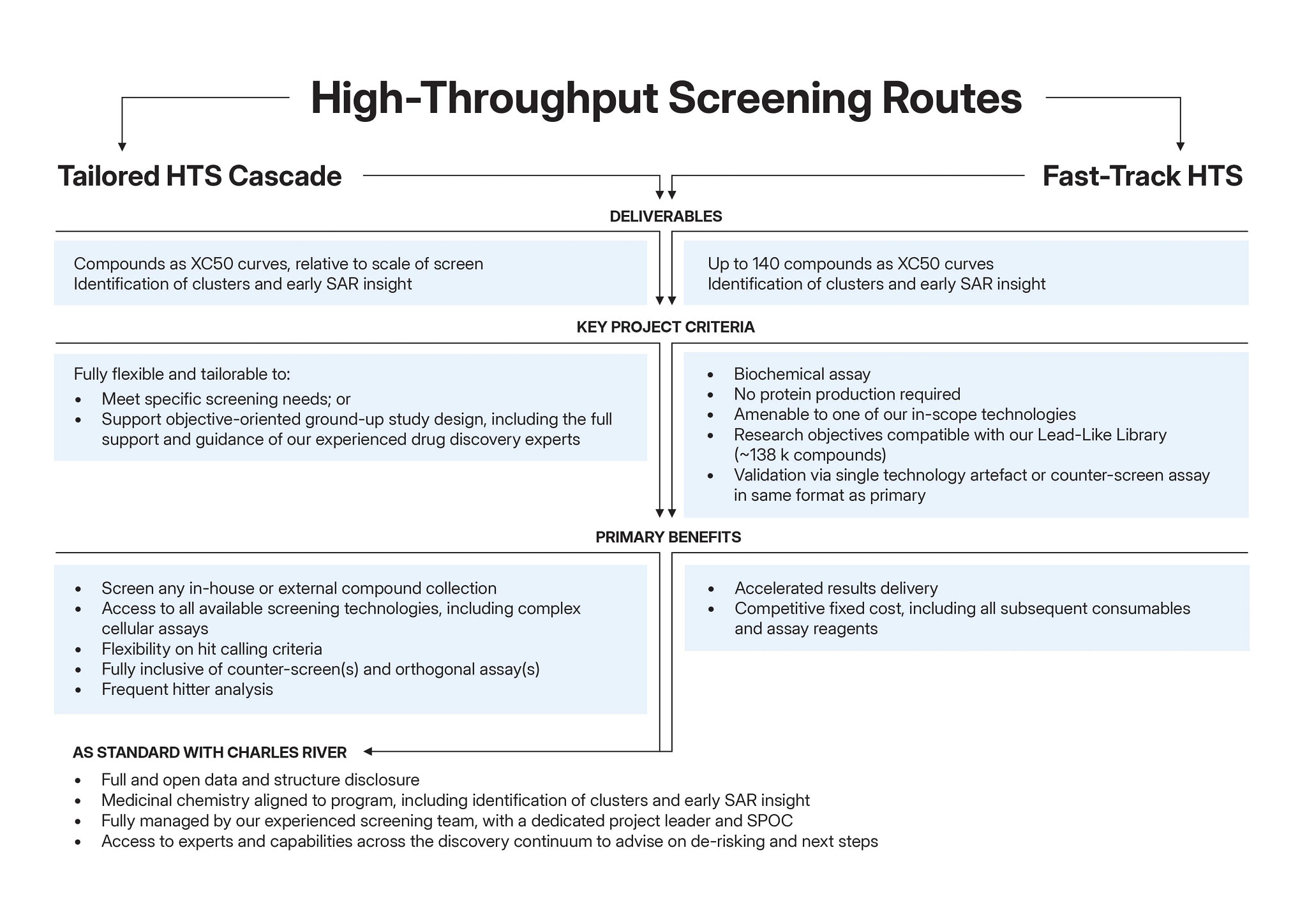
Tailored HTS Cascade
Our experienced scientists work in partnership with you to design a bespoke, tailored HTS program to meet your needs and budget. This fully flexible option covers a vast range of screening technologies, including complex cellular assays, ranging from simple endpoints to complex multi-parametric readouts to best suit your goals.
A tailored HTS offers a broad spectrum of assay development options; from an already established HTS assay transfer to complex assay development. Take advantage of the breadth of experts and capabilities available across our discovery services, including but not limited to, our experts in cell line development and structural biology. A tailored HTS is particularly well suited to meet specific screening needs, supporting objective-orientated ground-up study design, or challenging targets or phenotypes.
Some of the key advantages of choosing a tailored HTS include:
- Selection from over 1.4 million in-house compounds, including semi-exclusive libraries, or any external compound collection, beginning your hit identification campaign from the highest quality chemical starting point
- Access to all available screening technologies, including complex cellular assays
- Fully inclusive of counter-screen(s) and orthogonal(s) assays
- Full and open data disclosure, including visibility of all structures
- Flexible hit calling criteria and medicinal chemistry aligned as standard, providing frequent hitter analysis and hit matter with XC50s, clustering and early SAR insight
- Enhanced hit expansion using computational methodologies
Fast-Track HTS
A Fast-Track HTS maintains the same high standards and quality as a fully tailored screening cascade, but through optimization, streamlined processes and strategic standardization, we can offer a competitive fixed-cost price model, as well as expediting the execution time of an HTS program.
As initial results can be easily expanded upon and developed, Fast-Track HTS is particularly well suited to funding-limited research or PoC studies in which drug developers are looking to quickly explore the tractability or druggability of a target to gain proof of concept ahead of funding applications.
Some of the key advantages of choosing Fast-Track HTS include:
- Begin your drug development from a high-quality chemical starting point by screening against the Lead-Like Library, one of our premier collections curated for diversity and lead-like properties
- All assay reagents and consumables are included (excluding protein)
- Accelerated results delivery
- Full and open data disclosure, including visibility of all structures
- Up to 140 compounds delivered as XC50 curves, with clustering and early SAR insight
HTS Platform Options and Features
Our flexible HTS platform, broad scope of connected services and capabilities, and agile one-to-one approach enables researchers to create and implement hit campaigns which are optimized to produce data which can drive decisions, support research goals, and encourage investment.
Explore some of our key connected services and features:
-
Screening Set Design
Researchers may screen their own library or a full subset of a Charles River library. Alternatively, our CADD experts can work with you to design a targeted screening selection. Approaches for creating a curated selection include:
- Structure-based virtual screening from crystal structures or homology models
- Ligand-based virtual screening based on known active compounds
- Similarity / substructure searching around known active compounds
- Statistical / categorical model generation based around known active compounds
- Physicochemical property-driven selections
Researchers can also take advantage of computational selection for plate-based screening to create sets with desirable characteristics, such as maximizing structural representation, or bias towards known activities or property profiles.
-
HTS Assay Development
At Charles River, our drug discovery scientists bring deep expertise and extensive experience in HTS assay development, tailored to both target-based and phenotypic screening approaches. For target-based, we excel in developing and optimizing both biochemical and cellular HTS assays, utilizing cutting-edge technologies to ensure precise target engagement.
Our team is adept at engineering novel cell lines for custom target engagement assays and reporter-based systems, enhancing specificity and sensitivity. In phenotypic HTS, we leverage a wide array of leading assay platforms to identify compounds that impact complex biological pathways. Additionally, we integrate orthogonal assays into our screening cascades, ensuring comprehensive validation of hits by assessing activity across multiple mechanistic readouts, offering a thorough and streamlined approach to hit identification and lead optimization.
-
HTS Assay Validation
We ensure the highest level of assay validation using a variety of advanced software platforms, including robust quality management systems (QMS). Our data is processed through leading tools such as IBDS Activity Base, Titian Mosaic, Dotmatics, and GeneData Screener, ensuring precision and reliability throughout the screening process. We are committed to maintaining the accuracy, integrity, and confidentiality of all data generated via our high-throughput screening (HTS) platform, providing our clients with secure and transparent access to their results every step of the way.
-
Compound Management
Our compound management is executed with best-in-class equipment, including Titian management software and Echo liquid handling instruments. Our processes are designed to add simplicity and peace of mind, allowing you to focus on your discoveries.
Through advanced automation, we can facilitate complex logistics, rapid plate preparation, and integrated projects, seamlessly bringing together screening with chemistry, biology, ADME, and more. Our fully automated HTS platform allows you to screen in-house or client libraries of up to and exceeding one million compounds as a single or pooled compound(s) per well. We also have the capacity to store a copy of your library for multiple screening campaigns.
-
Alignment with Medicinal Chemistry
Our Medicinal Chemistry experts play a key role in your high-throughput screening program to ensure the successful identification and progression of high-quality chemical matter. With extensive experience in distinguishing true hits from false positives, we apply rigorous validation techniques, such as counter-screening and orthogonal assays, to establish confidence in the chemical matter identified during HTS campaigns.
Our medicinal chemists work closely with biologists to develop structure-activity relationships (SAR) around promising hits, providing a clear path to optimize potency and selectivity. In addition, we meticulously corroborate the mode-of-action (MoA) and confirm target engagement through biophysical and biochemical assays, ensuring that the compounds engage the intended target in a biologically meaningful way. By focusing on chemical diversity and identifying the most suitable, high-quality chemical series, we enable smooth progression from hit identification towards hit-to-lead, laying the foundation for a robust drug discovery pipeline.
-
Hit Expansion
Maximize your high-throughput screening investment by following up your initial hit matter with our proprietary CADD-driven hit expansion protocol. Prioritized hits from your HTS can be used to computationally select related, unscreened, compounds from our extensive collection or from external vendor libraries. Follow-on screening of these compounds allows you to enlarge your pool of hit matter into wider chemical space and generate additional understanding of the structure-activity relationship (SAR) of compound series.
Compound Library Quick Guide
Download this guide to obtain a breakdown of our >1.4 million chemical compounds, and learn about our processes for curation, QC, compound management, and screening set design.
Download now
Frequently Asked Questions (FAQs) About High-Throughput Screening (HTS) Services
-
What is high-throughput screening?
High-throughput Screening (HTS) is a hit identification approach in which many compounds (generally >10 k) are tested in a single screening activity. An HTS workflow will typically consist of:
- Assay development or assay transfer
- Compound set selection
- Pilot screen
- Primary screen
- Hit confirmation
- Potency determination
- Hit expansion
We use the below definitions to describe high-throughput screening:
- HTS (diversity screening): A screening paradigm that enables coverage of broad chemical diversity in a single activity, with few target prerequisites. Hundreds of thousands of compounds can be screened in each experimental run, in order to deliver fast, efficient, and (most crucially) consistent data.
- Phenotypic HTS: A diversity screening approach which employs a functional cellular assay as the primary screen (ideally in a disease-relevant cellular model). In this instance, it will be unclear as to mode of action (MoA) of the compounds that appear as "hits."
-
Can Charles River develop assays from scratch to support my high-throughput screening campaign?
Charles River has extensive experience in HTS assay development and HTS cascade design. Our expert teams can help design your entire cascade, developing all assays from scratch if required. We can source or generate high-quality screening protein and build transient or stable cell lines as required.
-
How does Charles River perform HTS assay validation? Are there key statistical criteria involved in this process?
We take many factors into account to validate the assays for your HTS cascade, including assay robustness, reproducibility, reagent stability, and overall cost. Where known modulating compounds / perturbant exist, these will be used to validate the assay system. We establish and monitor standard assay QC criteria including Z', Signal:background, CV, Inter+Intra plate effects (along with ensuring all equipment used is QC'ed appropriately).
Validation is key for success as HTS assays need to be robust enough to find hits from a single point. QC criteria for your screen will be agreed and set during assay development and then applied across your HTS campaign.
-
Does Charles River have preferred assay technologies for different target types?
Charles River has experience across a broad range of assay technologies. We can help advise on the best course of action once we know details of your target(s) or your phenotype of interest. The decision around screening approach / technology could be based on several factors, such as budget/reagent availability, or desired MoA, for example. Our expert team is available for consultancy on all technology types used across hit identification, from simple biochemical systems to complex multi-parametric cellular endpoints (such as high-content imaging [HCI], or automated E-Phys).
-
What compound libraries does Charles River use for high-throughput screening assay development?
Charles River has a number of exclusive libraries, including our Lead-Like and Diversity sets, and several libraries designed for specific biological target classes. We also have various annotated sets to help drive phenotypic programs and can provide virtual screening services for hit identification, which can run in parallel to or in place of wet lab HTS, dependent on your project needs.
-
What is the process for compound selection for high-throughput screening assays?
Charles River offers flexibility in the choice of compounds for screening, including selection of entire libraries, targeted selection, and computational selection of screening plates across a selection of different libraries. We can provide SD files to you, or our in-house CADD team can help select the relevant compound set for your needs (either maximizing diversity or biasing against additional criteria).
-
How long will an HTS campaign take from start to finish?
Your project timeline depends on multiple factors, and you will receive a clear estimate once we know the details of your project. Typically, a fast biochemical screening campaign of reasonable scale in 1536 would likely be approximately 20 weeks, if following a traditional cascade (primary screen – hit confirmation – potency determination). However, an HTS campaign could range anywhere between 4-40 weeks depending on the assay type, technology, cascade complexity and size of the library screened. Fast-Track HTS campaigns are typically rapid, reducing the overall campaign completion time significantly.
-
Is a tailored HTS program better than a Fast-Track HTS?
Our tailored and Fast-Track HTS programs are each designed to meet different needs and requirements. While Fast-Track HTS is available at a lower fixed cost and accelerated campaign delivery, all aspects of the program meet the same high standard as all Charles River services, with speed and price-point achieved through standardization and a streamlined screening cascade. Talk to our expert team to discuss which approach best suits your research objectives and anticipated program progression.