
Neutrophil Migration Assay
Neutrophils are one of the first responder cells recruited during an acute inflammatory phase. Upon recruitment to the site of infection, neutrophils kill extracellular pathogens through phagocytosis and release antimicrobial mediators, including reactive oxygen species and defensins. Neutrophil migration to the inflamed site is driven by chemokines such as IL-8, which is released by macrophages, endothelial cells, and epithelial cells.
IL-8, also known as CXCL8 or neutrophilic chemotactic factor, is a proinflammatory C-X-C chemokine that attracts neutrophils and induces their degranulation. IL-8 signals by binding to two G protein-coupled receptors: CXCR1 and CXCR2. Both receptors can lead to the activation of multiple downstream signaling pathways, including the phosphatidylinositol-3 kinase (PI3K)/Akt and the mitogen-activated protein kinase (MAPK) pathways. Neutrophil migration is known to contribute to several diseases, including acute respiratory distress syndrome, inflammatory bowel disease, rheumatoid arthritis, psoriasis, and tumorigenesis. Hence, monitoring the response of neutrophils to chemokines provides a pivotal characterization for the identification of candidate drugs. To study neutrophil migration mechanisms and to test the effects of candidate drugs on the modulation of neutrophil migration, we developed a chemotaxis assay using blood-derived human neutrophils. Identified cytokines can then in the future be studied in vivo across an immunology platform.
Boyden Chamber / Transwell® Cell Migration Assay Principle
The chemotaxis assay evaluates the migration of neutrophils through permeable supports (Transwell® or Boyden chamber) that contain 5.0 µm pore polyester membrane. Neutrophils are isolated from healthy blood donors using Ficoll separation and dextran-based sedimentation. Neutrophils are then seeded in the upper chamber of a 96-well Boyden chamber in serum-free medium, while chemoattractants and/or compounds are added to the lower chamber. After one hour, neutrophils that have migrated through the pores into the lower chamber are detected by measuring their ATP levels through a luminescent-based method (CellTiter-Glo®, Promega) and read with a plate reader.
The luminescence signal is directly proportional to the number of viable cells present in the lower chamber (Fig. 1).

Figure 1a. Chemotaxis assay principle with human neutrophils.
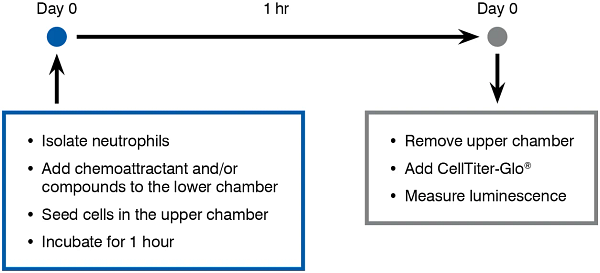
Figure 1b. Chemotaxis assay workflow with human neutrophils.
Neutrophil Chemotaxis Assay Setup
| Cell type → Neutrophils from healthy blood donors |
| Seeding density → 300,000 cells/insert |
| Trigger → IL-8 [10 nM] |
| Controls → Control: Serum-free medium (0.5% BSA) | Vehicle: 0.1 % DMS0 |
| Inhibitor → Sch527123 (IL-8 antagonist) in 8-point concentration-response curve [3 nM-10 µM] |
| Time → 1 hour |
| Readout → ATP levels (luminescent signal, Envision B) |
Quality Check (QC) of Isolated Human Neutrophils
Flow cytometry is used to perform a quality check (QC) of freshly isolated neutrophils. After isolation, cells are stained with a neutrophilic marker, anti-CD15 antibody and its relative isotype control, and analyzed by flow cytometry (Fig. 2). Donors that exhibit > 60% of CD15 expression will be used for the chemotaxis assay.
Figure 2. Neutrophil quality check.
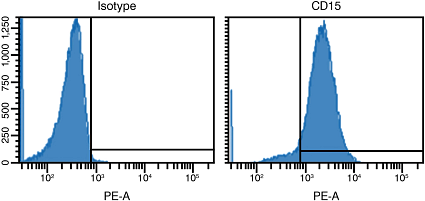
A. Representative flow cytometry histograms show 88.7% of CD15 expression on neutrophils isolated from one donor (left histogram). Isotype control staining shows no non-specific binding (right histogram).
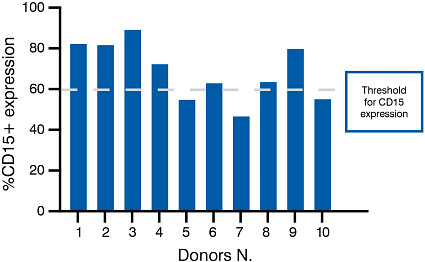
B. Percentage of CD15 expression on neutrophils isolated from different donors.
Neutrophil Migration Assay Validation Data
Performance of the developed assay was validated using the IL-8 antagonist, Sch527123 (CXCR1 and CXCR2 inhibitor), as a positive control for inhibition of migration together with the two assay controls (Control: Serum-free medium [0.5% BSA]; Vehicle: 0.1% DMSO). Data obtained on neutrophils isolated from two healthy donors (Donor 01 and 02) are reported below (Fig. 3).
Figure 3. Neutrophil chemotaxis responses.
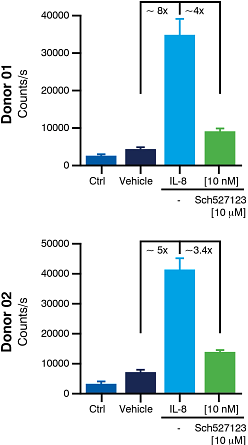
A. Assay windows obtained following the addition of the chemoattractant IL-8 in the absence and presence of its inhibitor (Sch527123) for two donors. Assay controls (Ctrl and Vehicle) are reported.
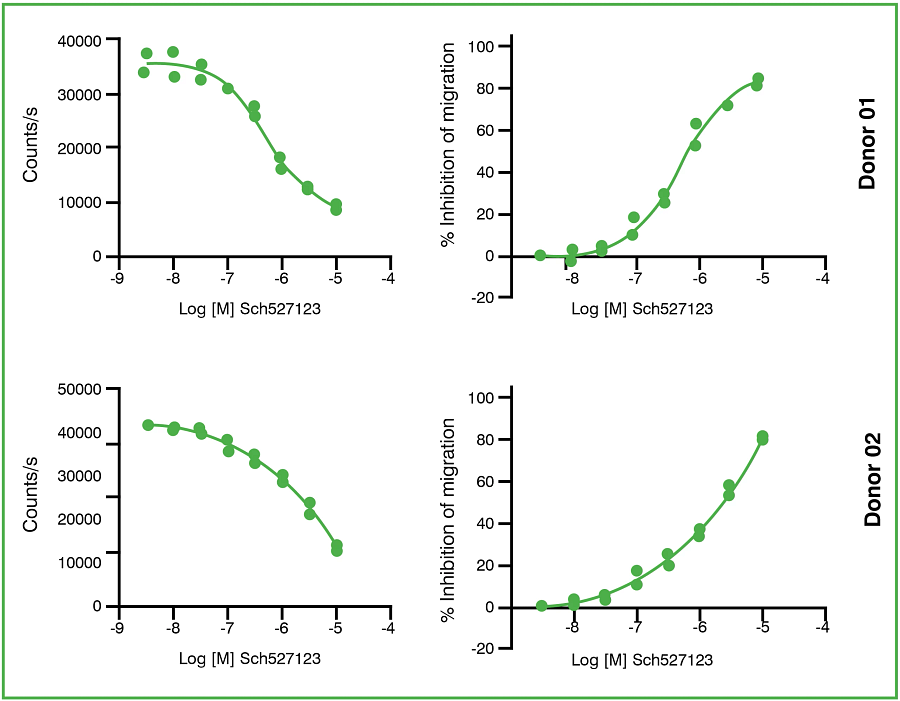
B. Representative concentration-response curves of Sch527123 (left panel) and the relative curve of inhibition (right panel) for neutrophils migration on two donors.
Summary
Migration of immune cells is an essential mechanism for resolution of tissue injuries, inflammation, and infections. This process is orchestrated by chemokines, which are small molecules that attract immune cells to the site of damage or infection. IL-8 is a key chemokine for the recruitment of neutrophils, promoting a series of physiological processes including neutrophilic migration, phagocytosis, exocytosis, and respiratory burst. IL-8 can bind to two receptors, CXCR1 and CXCR2, and contributes to the elimination of pathogens, tissue injury, fibrosis, angiogenesis, and tumorigenesis. Therefore, understanding the switches that regulate inflammatory responses and can prevent the development of chronic conditions is a very exciting field in inflammatory and autoimmune disease research.
Here we demonstrate an optimized chemotaxis assay allowing the modulation of IL-8-induced migration of human neutrophils isolated from healthy blood donors through 5 µm pore-size inserts in a Boyden chamber setting. IL-8 at 10 nM strongly induces the migration of human neutrophils that is inhibited by the addition of IL-8 antagonist (Sch527123) in a dose-dependent fashion. IC50 values were consistent across different donors (not shown). Results are provided as percentage of inhibition normalized (PIN) values.
Using this immunology assay, migration of neutrophils isolated from human blood donors can be monitored to evaluate therapeutic candidates for the treatment of inflammatory diseases and chronic inflammatory conditions.