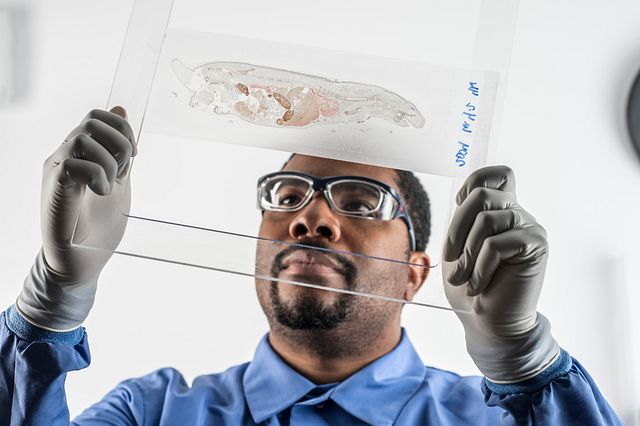
Tissue Distribution Studies
Drug tissue distribution is a complex process dependent on a long list of parameters that affect the delivery, retention, and removal of a drug into and out of biological tissues. Once a drug enters the systemic circulation, distribution is commonly uneven due to the differences in blood perfusion, plasma protein and tissue binding, pH, rate of blood flow, partition characteristics and more.
Charles River has experience in conducting single and repeated dose radiolabeled tissue distribution studies using either tissue dissection or quantitative whole-body autoradiography (QWBA) methods to meet the sensitivity and specificity required for a comprehensive ADME program.
Single vs. Repeat Dose Tissue Distribution
A single dose tissue distribution study provides information for designing toxicology and pharmacology experiments and for interpreting the results of these studies. The data generated is also required to calculate the radioactive dose that can be authorized for a clinical ADME study. Repeated dose tissue distribution studies are designed for compounds with a long half-life in the tissues compared to plasma, drugs intended for a site specific targeted delivery system, incomplete elimination or unanticipated organ toxicity. The design and timing of repeated dose studies are determined on a case-by-case basis.
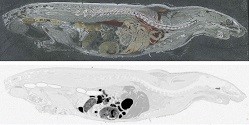 QWBA provides a quantitative measure of distribution and the high-resolution digital image obtained from a phosphor image can be enlarged to provide greater depth and detail of distribution in the tissues or organs of interest.
Your Questions Answered by Tissue Distribution/QWBA Studies
-
Why conduct a tissue distribution/QWBA study?
Tissue distribution/QWBA studies answer the following questions:
- Does my drug penetrate the BBB?
- Does my drug reach the intended target? What is the extent of target engagement?
- Does my drug distribute or accumulate in specific tissues or organs?
- What is the tissue half-life? (establish a time course of drug and metabolites in blood and tissue).
- Does tissue exposure correlate with histopathological changes in toxicology study?
Additionally, data from these studies can assist in the calculations of human radiological exposure (dosimetry).
-
Tissue distribution/QWBA study applications
- Tissue distribution
- Target organ/tissue validation
- Correlation with histopathology
- Placental transfer
- Penetration of blood-brain barrier
- Tumor penetration
- Support of micronucleus test
- Dermal/ ungual penetration
- Human dosimetry calculations
-
Isotope detection and labeling services
- Carbon-14
- Gadolinium-153
- Iodine-125
- Phosphorus-32
- Strontium-89
- Sulfur-35
- Iron-59
- Tritium
- Other beta or gamma emitters
- Dual isotope imaging available for complex molecules via wet dissection technique
-
How to prepare for tissue distribution/QWBA studies
Before you begin these studies, you must know the following information:
- What is the indication?
- Route of administration?
- Determine appropriate dose level where no clinical signs or toxicity (NOEL)
- Clinical plan and treatment regimen
- In vitro ADME and transporter data as metabolism cycles can change with each passage, i.e., first or second pass metabolism
- What is the relevant regulatory agency expecting?
A full ADME package should be included in your NDA and conducted prior to Phase III clinical, although earlier in the process can help avoid late-stage attrition or even failure.
-
Recommended study designs
- Biodistribution group utilizing QWBA or wet tissue dissection technique
- Pharmacokinetic (PK) group, as the previous PK of the parent drug may not be reflective of total radioactivity in plasma due to metabolites
- Excretion mass balance group
- Bile collection group with cannulated animals
Elucidation of drug tissue distribution in preclinical species can help identify potential target tissues for toxicity or confirm suitable exposure of the therapeutic target. Charles River can support you in procuring this information with the effective design, conduct and delivery of traditional tissue distribution by dissection of wet tissues or QWBA studies as part of our preclinical drug metabolism service.
Tissue distribution data combined with metabolite profiling provides insights to complex metabolic pathways
Identify your metabolites, as active metabolites can interact with other targets and produce undesirable effects.
Learn More
In addition to tissue distribution studies, we offer a full range of drug metabolism and pharmacokinetic studies in support of drug candidate selection or regulatory submission. Our skilled pharmacokineticists, surgeons, toxicologists, and bioanalytical chemists work together to design and interpret both in vitro and in vivo components of your metabolism studies, which can vary based on your program goals.
Need help understanding your compound’s ADME properties?
Frequently Asked Questions (FAQs) About Tissue Distribution and QWBA Services
-
What does the acronym QWBA stand for?
QWBA stands for quantitative whole-body autoradiography and is a technique used to determine both visually and quantitatively the tissue distribution of radiolabeled compounds in preclinical species. This high-resolution method is used to characterize drug absorption, distribution, metabolism, and excretion using nonclinical biological samples to help predict human ADME properties prior to the clinic. The QWBA imaging technique most commonly used is a phosphor imager however an alternative option is MALDI-MSI (matrix-assisted laser desorption/ionization mass spectrometry imaging).
-
Why conduct drug tissue studies?
To help ensure that patients are not exposed to dangerous drug and/or drug metabolite levels, regulatory agencies require drug developers to characterize the ADME properties of prospective new drugs. Quantitative whole-body autoradiography (QWBA) delivers quantitative tissue concentration data and a visual location of those concentrations in intact organs, tissues, and cells in nonclinical species. The tissue distribution data generated from either the wet dissection or QWBA technique is a necessary part of a comprehensive ADME strategy package that aids dosimetry calculations for planning human radiolabeled ADME studies.