
Reinvigorate T Cell Exhaustion for Optimal Control of Infection and Tumors
The immune system is capable of distinguishing between danger and non-danger signals, thus inducing either an appropriate immune response against pathogens and cancer or inducing self-tolerance to avoid autoimmunity and immunopathology. One of the mechanisms that has evolved to prevent destruction by the immune system is to functionally silence effector T cells. Known as T cell exhaustion, this mechanism is also exploited by viruses and cancers for inducing immune escape. T cell exhaustion is a state of T cell dysfunction that arises during many chronic infections and cancer. It is defined by poor effector function, sustained expression of inhibitory receptors, and a transcriptional state distinct from that of functional effector or memory T cells.
Exhaustion prevents optimal control of infection and tumors. Currently, multiple strategies are being explored to reinvigorate exhausted T cells by either small molecule or therapeutic antibody approaches, alone or in combination. These include blocking some of the inhibitory phenotypic surface markers associated with T cell exhaustion (PD-1, PD-L1, CTLA4 LAG-3, Tim-3, and TIGIT), or activating agonistic mAbs targeting activating receptors on T cells (CD137, OX40, GITR) or antigen-presenting cells (APCs) (anti-CD40 mAbs) and inhibitors of soluble mediators targeting IDO, A2aR, CSF1R, IL10, or TGFβ (reviewed by Zarour HM, 2016).
Staphylococcal enterotoxin B (SEB) is an enterotoxin produced by the Gram-positive bacteria Staphylococcus aureus. It is a common cause of food poisoning due to its stable biophysical nature. SEB used at low concentrations binds to the class II major histocompatibility complex (MHC) antigens expressed on professional antigen presenting cells (APCs) and the T cell receptor at the variable region of the β-chain. As this binding event occurs on a subset of TCR Vβ domains, a substantial number of T cells are activated by SEB, resulting in the up-regulation of activation markers and proliferation.
SEB is also a known as superantigen, as it can trigger polyclonal T cell activation and trigger systemic release of pro-inflammatory cytokines such as IL-2, IL-6, TNFα, and IFN-γ which can be quantified using the Meso Scale Discovery multiplex platform. Identified cytokines can be future studied in vivo across an immunology platform.
T Cell Exhaustion Assay Principle
In this assay, freshly isolated human PBMCs are stimulated with a fixed concentration of SEB for three days. The media is harvested for IL-2 and IFN-γ measurements. Cells are washed and re-suspended into assay media in the absence or presence of therapeutic molecules to evaluate T cell activation response.
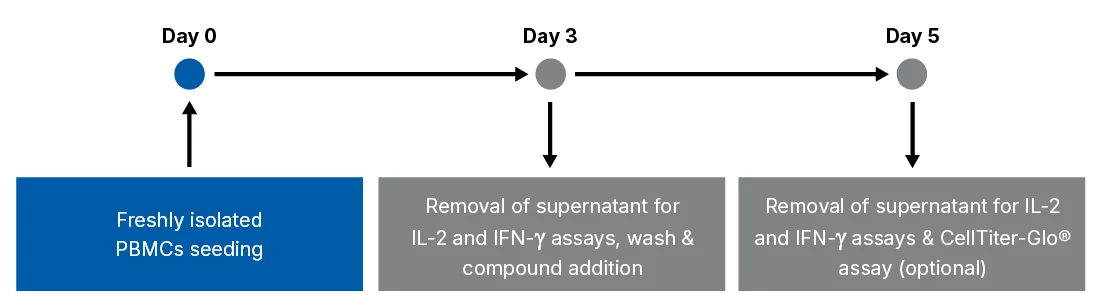
Figure 1
A.
B.
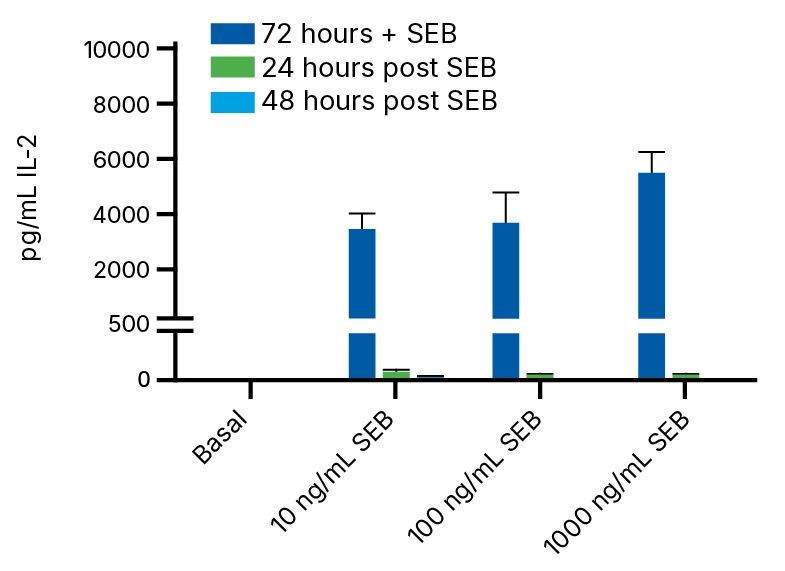
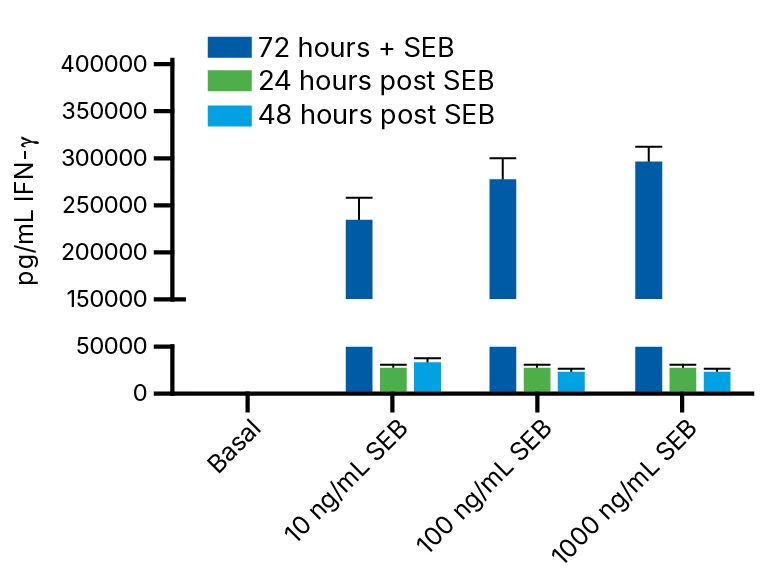
Representative data showing concentration dependent increase in IFN-γ (A) and IL-2 (B) with SEB stimulation (blue bars).
High-level stimulation of IFN-γ and IL-2 production was measured post three days stimulation with 10-1,000 ng/mL SEB. Multiple donors were tested (data not shown).
A large reduction in both IFN-γ and IL-2 production observed 24 and 48 hours post SEB withdrawal.
Figure 2
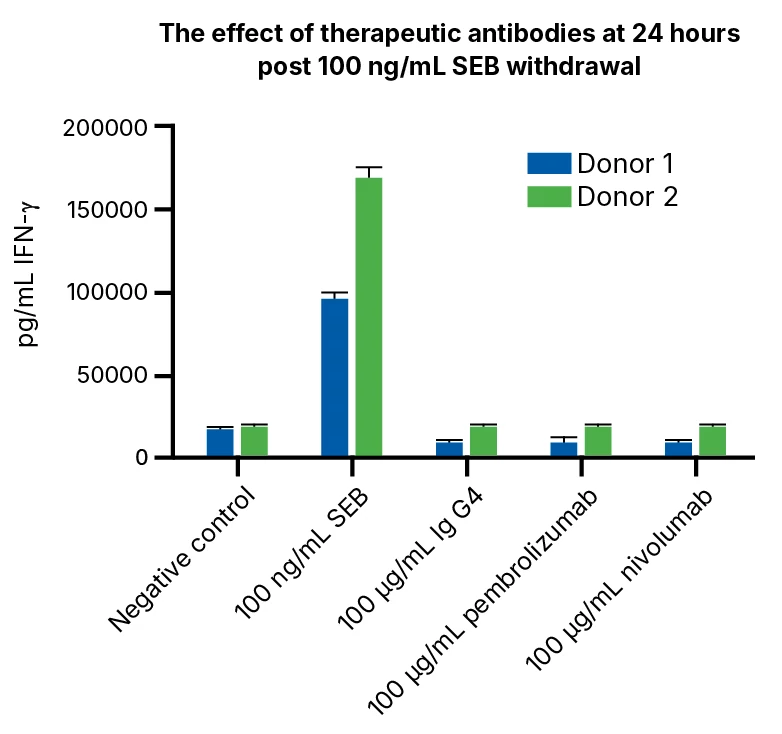
Representative data showing the evaluation of two anti-PD-1 antibodies (pembrolizumab and nivolumab) in the T cell exhaustion assay at 24 hours post SEB stimulation. Similar data was also obtained at 48 hours (data not shown).
| Performance |
|---|
| Donor → PBMCs |
| Seeding density → 200,000 cells/well |
| Trigger (positive control) → 100 ng/mL SEB or a therapeutic agent known to reverse T cell exhaustion |
| Negative control → No trigger |
| Readout → IFN-y and IL-2 production by MSD assays |
A Distinct Epignetic Profile of Exhausted T Cells
Exhaustion of T cells prevents optimal immune response and hence the control of infection and cancer. The ability to reinvigorate T cells is a therapeutic strategy that is currently being explored to help induce appropriate immune response against pathogens and cancer. It has been reported that exhausted T cells acquire an epigenetic profile distinct from effector or memory T cells (Pauken, K et al, 2016). These latter two cell types can mount effective immune responses to viruses and tumors, whereas exhausted T cells fail, in particular, for long-lasting durable effects. Epigenetics is the way chemical modifications to DNA and the proteins binding DNA determine which genes are expressed by a cell type. Epigenetic profiles can be highly stable and confer long-term identity of a cell. The unique epigenetic profile of exhausted T cells causes these cells to express a different overall set of genes compared to memory or effector T cells. However, this epigenetic pattern was only minimally changed following the PD-L1 blockade (Pauken, K et al, 2016). This prevented these exhausted T cells from changing into the more protective effector or memory cell types.
Using this immuno-oncology assay, we can monitor the ability of therapeutic agents (small molecules or antibodies) to reverse T cell exhaustion induced by low concentrations of SEB by measurement of the pro-inflammatory cytokines IL-2 and IFN-γ. An endpoint measurement of cell proliferation can also be incorporated using the CellTiter-Glo® assay.