
Computational Drug Design Using Cryo-EM Services
Cryo-EM-based computational drug design allows for deeper structural insights into the target-ligand interactions for your compound, in addition to a better understanding of flexibility and discrete conformational states adopted by the target. This deep-dive into the make-up and functionality of your target enables data-driven decision making and informed action as your compounds progress through the discovery and development process.
The ATEM cryo-EM platform brings together biochemistry, hardware, and software into a solution which can facilitate even the most challenging of targets. Samples are optimized, flash frozen in a broad range of naturally occurring states, and then used to build accurate empirical 3D dynamic structural models.

Explore the Latest Innovations in Structure-Based Drug Design
Structural biology is undergoing an exciting transformation. In this webinar, you will discover how structure-based drug design is accelerating in both capability and importance. Learn more about emerging technologies like Cryo-EM, the resolution of new kinds of structures, and other technological advances in the field.
Watch Now
Determine Structures for Difficult Targets With Cryo-EM
An excellent option for challenging structural biology projects, cryo-EM enables the determination of full-length, high-resolution 3D structures of your target-compound, including large, complex, and fragile assemblies. This technology makes it possible to visualize and interrogate the entire structure of targets in a more native environment rather than isolated domains due to the ability of cryo-EM to analyze and model significant flexibility. Once an apo platform is achieved, multiple small molecules or biological ligands can be added to the target and complex structures determined.
Cryo-EM is well suited for challenging and large structures, including:
- Monoclonal antibodies
- Membrane proteins
- Large multiple subunit proteins
- AAVs
Gain Functional Dynamic Insight into your Targets
Analyzing candidates against a single structural state may not yield comprehensive results, as biological targets are naturally dynamic in their native environment. To aid compound design with optimal functional effect in mind, ATEM can provide multiple structural models for different conformational states to illustrate how this natural dynamic fluctuation synergizes with other molecules and compounds. This dynamic approach helps to interrogate hit rates more comprehensively and provides an opportunity to move some biochemical functionality wet laboratory studies into a virtual environment.
Examine Dynamic Candidate Interaction and Interference With Our Cryo-EM Services
The ATEM cryo-EM platform is able to capture and illustrate the natural motion of protein complexes via empirical 3D dynamic structural models, allowing for the examination of binding interaction and interference between the target and ligands / small molecules. This additional in-depth insight into the biochemical mechanics of your compounds empowers data-driven downstream study design.
The platform also enables precise 3D epitope mapping, generating high resolution epitope maps to support drug design programs and patent applications; target structures are mapped in conjunction with monoclonal antibody candidates (mAbs and Fabs).
Should you Opt for X-Ray Crystallography or Cryo-EM?
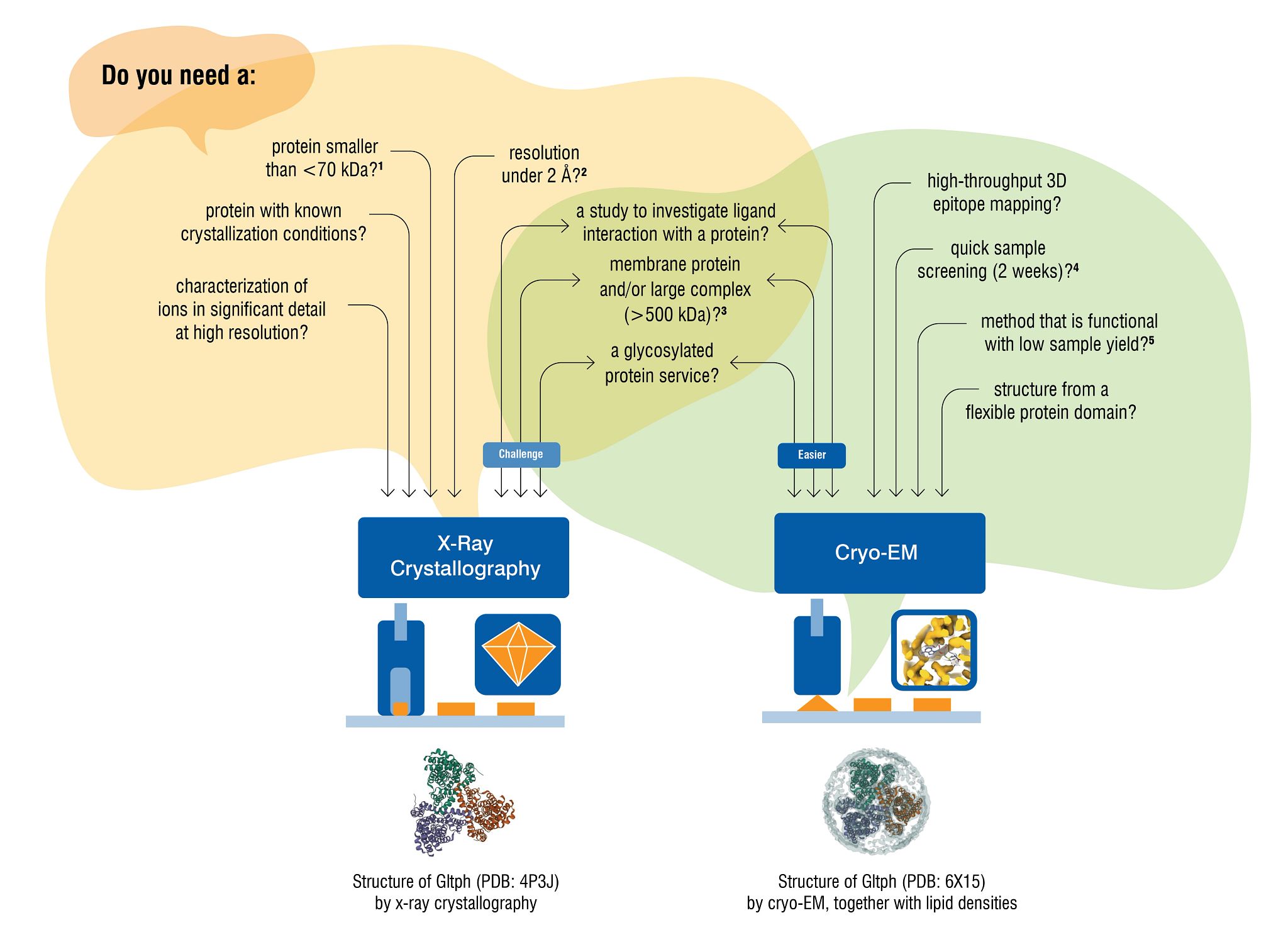
Benefits and Differences of Cry-EM and X-ray Crystallography
1. Small proteins are more suitable for x-ray crystallography since they can be difficult to discern by cryo-EM.
2. X-ray crystallography can obtain very high resolutions, although cryo-EM has had comparable results in recent years.
3. Large structures, complexes, and membrane proteins can be difficult to crystallize. Cryo-EM might therefore be an easier option.
4. EM (negative stain) offers rapid screening of samples to rule out aggregation and determine oligomerization, giving a visual overlook of how the sample behaves and what it contains.
5. Cryo-EM requires lower protein amounts than x-ray crystallography. This method might benefit samples with a yield of under 2 mg protein (<5-10 mg/ml).*
*0.2mg can be usable for low expressing membrane proteins.
Frequently Asked Questions (FAQs) About Cryo-EM Services
-
How long does cryo-EM take?
Timescales can vary for challenging targets. In the case of either a sufficiently large (>100kD) soluble protein or membrane protein that has been shown to be monodispersed in solution, screening can typically be completed in as little as a week once a study has begun, with subsequent data collection and processing in as little as two weeks. Talk to us about your specific project requirements for a lead time estimate.
-
What resolution is possible with Cryo-EM?
The current record for resolution from Cryo-EM is 1.2 Angstroms, for an ideal sample with the best hardware and software currently available. In real world examples, for straightforward samples, achieving around 2.5 Angstroms or better is very possible.
-
How does Cryo-EM compare against X-Ray Crystallography for SBDD?
Cryo-EM has opened up the possibilities for doing SBDD on targets previously impossible via X-Ray Crystallography due to their flexibility or membrane bound nature. Great success has been achieved by many pharmaceutical companies in using Cryo-EM to support SBDD predominantly in lead optimization. However, as Cryo-EM can require a slightly longer timeframe to generate new structural information, X-Ray Crystallography is still often preferred on a project-by-project basis.
-
How much protein do you need?
Protein usage for Cryo-EM is considerably lower than required for crystallography, in some cases as little as 10ul at 0.2mg/ml can result in a high resolution structure. However, for a new target, several mg’s is preferable for multiple rounds of optimization to ensure high resolution data is achievable.
-
Can a Cryo-EM structure provide additional information in comparison to an X-Ray structure, and how does this benefit drug design?
Cryo-EM structures, due to their in-solution nature, give a more accurate representation of the conformation of the target in its native state. In addition, with flexible proteins that adopt multiple states during functional cycles, it is possible to identify these different states from a single dataset which can benefit drug discovery by enhancing the understanding of how therapeutic binding sites can change depending on the conformational state of the target.