
Gel-Clot Endotoxin Test Reagents and Endpoint Chromogenic LAL Kit
As the original BET method of testing, a gel-clot endotoxin test is one of the simpler assays that can be conducted that yields qualitative results indicating the presence of endotoxins. This is determined through a clotting response and is a quick and effective way to detect harmful endotoxins for your injectable pharmaceuticals.
As part of our mission to provide scientifically sound and sustainable solutions, we've developed and optimized a robust, animal-free kinetic chromogenic rCR bacterial endotoxin detection assay curated to simulate the natural LAL reaction. Learn more about going animal-free.
-
Gel-Clot LAL Reagents Product Codes
Product Sensitivity EU/mL Format Code 10-Test vial (1.2 mL) 0.030 EU/mL Pack of 6 R12003PK Box of 100 R12003BX 0.060 EU/mL Pack of 6 R12006PK Box of 100 R12006BX 0.125 EU/mL Pack of 6 R12012PK Box of 100 R12012BX 0.25 EU/mL Pack of 6 R12025PK Box of 100 R12025BX 50-Test vial (5.2 mL) 0.015 EU/mL Pack of 6 R15015PK Box of 100 R15015BX 0.030 EU/mL Pack of 6 R15003PK Box of 100 R15003BX 0.060 EU/mL Pack of 6 R15006PK Box of 100 R15006BX 0.125 EU/mL Pack of 6 R11012PK Box of 100 R11012BX 0.250 EU/mL Pack of 6 R11025PK Box of 100 R11025BX -
Endpoint Chromogenic Reagent Product Code
Our gel-clot endotoxin test endpoint chromogenic reagent is a non-kinetic LAL assay that yields quantitative results quickly over a narrow standard curve range. This gel-clot endotoxin test reagent eliminates the need for an incubating plate reader, decreasing the testing time in comparison to a standard gel-clot endotoxin test. For many applications, the Endosafe® nexgen-PTS™ offers advantages of speed and convenience to the endpoint user.
Product Code Endpoint Chromogenic Kit - 140 tests R160
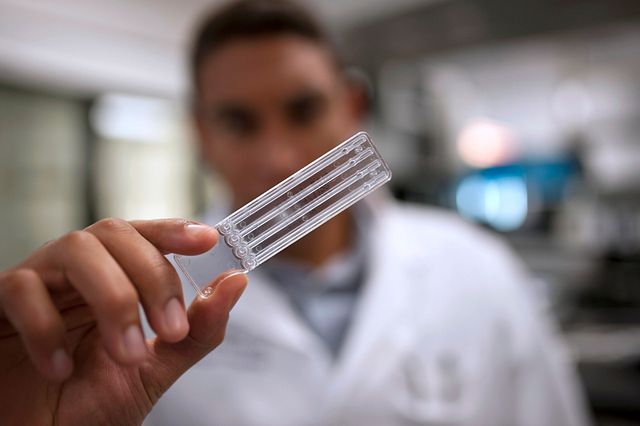
Cartridge, Kinetic, or Gel-Clot?
Whatever you're testing, whichever testing method you choose, our Endosafe® reagents have you covered. See which one is best for your organization.
Identify your Ideal Workflow
Frequently Asked Questions (FAQs) About Gel-Clot Endotoxin Testing
-
How does the gel-clot endotoxin test work?
The gel-clot endotoxin test method displays the presence of endotoxins based on whether gel clot forms in the sample tube when introduced to the LAL reagent. If endotoxin is present in the sample, a gel clot will occur when in contact with the LAL reagent. If the clot stays at the bottom of the test tube after inverting it, the sample is positive for endotoxin.
-
When would you use a gel-clot endotoxin test?
A gel-clot endotoxin test is one of the simpler assays that can be conducted that yields qualitative results indicating the presence of endotoxins. As the original BET method of testing, the gel-clot endotoxin test should be used when you have samples that:
- Are extremely viscous
- Are extremely colorful such as red, orange, and yellow
- Contain particles, precipitation, or Trypsin
- Can cleave pNA
If you are testing more than 10 samples a month, prefer endotoxin calculations to be performed using validated software, or quantitative results over qualitative results, we recommend moving to a kinetic turbidimetric endotoxin testing method or using our Endosafe cartridge technology with one of our endotoxin testing instruments: Endosafe® nexgen-PTS™, Endosafe® nexgen-MCS™ or the Endosafe® Nexus 200™.
-
What equipment is used when performing a gel-clot endotoxin test?
The gel-clot endotoxin test uses a heater block or water bath for instrumentation and several accessories, such as dilution tubes, pipettes, and pipette tips.
-
Why would I switch from a gel-clot endotoxin testing method to Endosafe cartridge technology?
There are several reasons to switch to Endosafe cartridge technology from the gel-clot method that would benefit your company, such as:
- Reduce chance for human error
- Increase data integrity
- Reduce LAL usage
- Purchase less accessories
- Reduce retest rates
- Reduce technician training time
-
Where do I find verification that the gel-clot endotoxin test is a compendial method?
The gel-clot endotoxin test is a compendial method per the USP<85> and Ph.Eur.<2.6.14>.