
Kinetic Turbidimetric Reagents
Our two kinetic turbidimetric LAL endotoxin test reagents, KTA and KTA2, yield quantitative endotoxin values when used with a microplate reader equipped with endotoxin-measuring software. Both reagents are buffered to provide significant interference-resistance properties and are FDA-licensed for use in product release testing. Our kinetic turbidimetric endotoxin test reagents are buffered to provide the best interference-resistance properties.
With KTA and KTA2, you will receive accurate endotoxin results on even your most difficult products in the same amount of time it takes to run a test. Our exceptional kinetic turbidimetric endotoxin test formulations are licensed for kinetic and gel-clot analyses and allow for a direct correlation between the methods.
As part of our mission to provide scientifically sound and sustainable solutions, we've developed and optimized a robust, animal-free kinetic chromogenic rCR bacterial endotoxin detection assay curated to simulate the natural LAL reaction. Learn more about going animal-free.
KTA
Our traditional kinetic turbidimetric assay reagent (KTA) is suitable for both kinetic and gel-clot analyses and permits a direct correlation between LAL methods.
-
KTA Sensitivity and Product Codes
50-Test Vial (5.2 mL)
Product Sensitivity EU/mL Format Code KTA / Gel-Clot LAL 50-Test
0.015 EU/mLPack of 6 R15015PK Box of 100 R15015BX 50-Test
0.030 EU/mLPack of 6 R15003PK Box of 100 R15003BX 50-Test
0.060 EU/mLPack of 6 R15006PK Box of 100 R15006BX
KTA2
Our second-generation reagent KTA2 offers one of the fastest turbidimetric LAL reaction times on the market, and our optimized formulations offer an unrivaled combination of sensitivity, linearity, and interference resistance properties with minimal assay times. Its superior turbidimetric formulation offers the performance of a kinetic chromogenic LAL test at the price of a turbidimetric reagent.
-
KTA2 Sensitivity and Product Code
Product Sensitivity EU/mL Format Code KTA2 50-Test Vial, KTA2 Pack of 6 R19000PK Box of 100 R19000BX
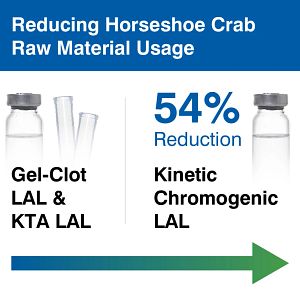
Is Your BET Program Sustainable?
We recognize every organization has their own directives on how to embrace the 3R principles while ensuring product quality and patient safety. Our extensive portfolio has transformed the way we approach endotoxin detection, each offering their own degree of sustainability while allowing us to further optimize our resources and continue our shared journey to reduce reliance on the horseshoe crab.
Embrace Greener Techniques
Frequently Asked Questions (FAQs) About LAL Kinetic Turbidimetric Assays
-
How much LAL is used per sample replicate in a kinetic turbidimetric endotoxin test?
There is 100μL of LAL in each well for a kinetic turbidimetric endotoxin test.
-
How long does it take to run a kinetic turbidimetric endotoxin test?
The length of time to run a kinetic turbidimetric endotoxin test ranges from 30-60 minutes depending on the standard curve range.
-
Which types of samples work well with a kinetic turbidimetric LAL endotoxin test?
Colorful samples such as red, orange, and yellow or Trypsin that can cleave to pNA work well with a kinetic turbidimetric LAL endotoxin test.
-
Where can I find verification that the kinetic turbidimetric LAL endotoxin test is a compendial method?
The kinetic turbidimetric LAL endotoxin test is a compendial method per the USP<85> or Ph.Eur.<2.6.14>.
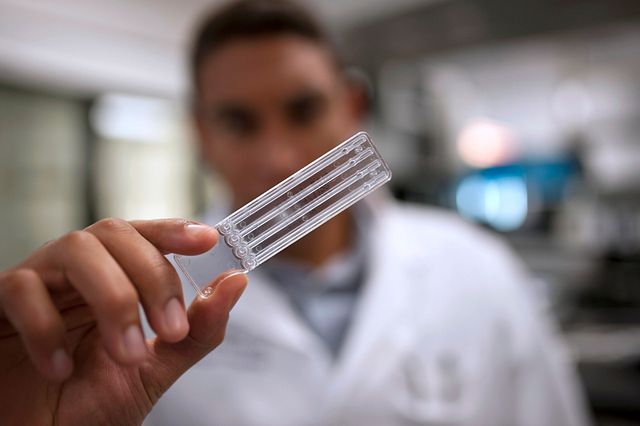
Cartridge, Kinetic, or Gel-Clot?
Whatever you're testing, whichever testing method you choose, our Endosafe® reagents have you covered. See which one is best for your organization.
Identify your Ideal Workflow