
Choosing Nude Mouse Models for Tumor Biology and Xenograft Studies
Charles River's nude mouse models, including the well‑established nu/nu and athymic nude mice, are specifically designed to support in vivo tumor growth without immune rejection. These models are ideal for xenograft studies and provide valuable insight into cancer progression, therapeutic efficacy, and immune system dysfunction. By offering consistent performance and well‑characterized immune deficiencies, Charles River nude mice support researchers across the entire preclinical pipeline—from exploratory research through translational development.
Charles River maintains six live nude mouse model strains:
- Athymic Nude Mouse*
- BALB/c Nude Mouse
- CD-1® Nude Mouse
- NIH-III Nude Mouse
- NU/NU Nude Mouse
- SCID Hairless Outbred (SHO®) Mouse
* Download xenograft data for the athymic nude mouse.
Animal Model Evaluation Program
Through our model evaluation program, you can actively assess the quality and compatibility of our nude mouse models before making any commitments. Learn More
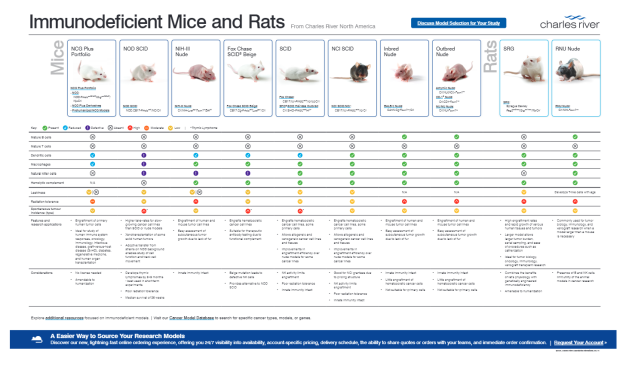
Immunodeficient Models Poster – Your Guide to Model Selection
Explore side-by-side comparisons of nude and other immunodeficient mouse and rat strains and learn about model characteristics, immune deficits, and research applications.
Key Characteristics of Nude Mice
- Genetic Background – Carries a mutation in the Foxn1 gene, impacting both hair growth and thymus development
- Immune System – Deficient in T cells but retains functional B cells and natural killer (NK) cells
- Hairlessness – The most visible trait; helps researchers facilitate tumor measurements post-implantation and over time
- Immune Deficiency – Lacks cell-mediated immunity, making the strain permissive to xenografts
- Housing Needs – Must be kept in SOPF/VAF Elite® or sterile environments to prevent infections
- Shortened Lifespan – More susceptible to diseases due to limited immune protection

Cancer Model Database
Search in vivo and in vitro models by tumor histology, patient characteristics, whole exome mutations, gene expression, copy number alterations, and recommended rodent host strains. Quickly identify the most relevant PDX, CDX, cell line, and syngeneic models for your oncology or immuno-oncology research program.
Get Access
Selecting the Right Nude Mouse Model
What is a Nude Mouse?
Nude mice are a widely used laboratory mouse model characterized by their lack of body hair and deficient immune systems. These mice are born with a mutation in the Foxn1 gene, leading to the absence of a functional thymus gland—a critical organ for the development of T lymphocytes (T cells). Without mature T cells, nude mice are unable to mount a full adaptive immune response, making them an essential tool in preclinical research.
How Can I Choose the Right Nude Mouse Model?
Selecting the most appropriate mouse model is an essential step in designing an oncology study. To assist researchers in expediting the selection of a nude mouse, Charles River has compiled these resources:
Did You Know We Deliver Drug Discovery Services from Day One?
Charles River offers a range of translational oncology studies, including in vitro assays and in vivo models, that mirror human cancers. Whether you want to test your therapy in a cell biology assay consisting of the elements of the tumor microenvironment or in models using real patient tissue, we can help.
Learn More

Selected Publications Citing Charles River Nude Mice
-
Publications
Hemming ML, et al. Preclinical Modeling of Leiomyosarcoma Identifies Susceptibility to Transcriptional CDK Inhibitors through Antagonism of E2F-Driven Oncogenic Gene Expression. Clin Cancer Res. 2022 Jun 1;28(11):2397-2408. doi: 10.1158/1078-0432.CCR-21-3523. PMID: 35325095; PMCID: PMC9167705.
Schulz M, et al. Cellular and Molecular Changes of Brain Metastases-Associated Myeloid Cells during Disease Progression and Therapeutic Response. iScience. 2020 Jun 26;23(6):101178. doi: 10.1016/j.isci.2020.101178. PMID: 32480132; PMCID: PMC7262568.
Wang Z, et al. Arsenic and benzo[a]pyrene co-exposure acts synergistically in inducing cancer stem cell-like property and tumorigenesis by epigenetically down-regulating SOCS3 expression. Environ Int. 2020 Apr;137:105560. doi: 10.1016/j.envint.2020.105560. PMID: 32062438; PMCID: PMC7099608.
Dandawate P, et al. Diphenylbutylpiperidine Antipsychotic Drugs Inhibit Prolactin Receptor Signaling to Reduce Growth of Pancreatic Ductal Adenocarcinoma. Gastroenterology. 2020 Apr;158(5):1433-1449.e27. doi: 10.1053/j.gastro.2019.11.279. PMID: 31786131; PMCID: PMC7103550.
Dumani DS, et al. Ultrasound-guided immunofunctional photoacoustic imaging for diagnosis of lymph node metastases. Nanoscale. 2019 Jun 20;11(24):11649-11659. doi: 10.1039/c9nr02920f. PMID: 31173038; PMCID: PMC6586492.
Liu Z, et al. Induction of store-operated calcium entry (SOCE) suppresses glioblastoma growth by inhibiting the Hippo pathway transcriptional coactivators YAP/TAZ. Oncogene. 2019 Jan;38(1):120-139. doi: 10.1038/s41388-018-0425-7. PMID: 30082911; PMCID: PMC6318057.
Muralidharan R, et al. Tumor-targeted Nanoparticle Delivery of HuR siRNA Inhibits Lung Tumor Growth In Vitro and In Vivo By Disrupting the Oncogenic Activity of the RNA-binding Protein HuR. Mol Cancer Ther. 2017 Aug;16(8):1470-1486. doi: 10.1158/1535-7163.MCT-17-0134. PMID: 28572169; PMCID: PMC5544587.
Andriani F, et al. Conversion to stem-cell state in response to microenvironmental cues is regulated by balance between epithelial and mesenchymal features in lung cancer cells. Mol Oncol. 2016 Feb;10(2):253-71. doi: 10.1016/j.molonc.2015.10.002. PMID: 26514616; PMCID: PMC5528953.
Brehar FM, et al. The development of xenograft glioblastoma implants in nude mice brain. J Med Life. 2008 Jul-Sep;1(3):275-86. PMID: 20108505; PMCID: PMC3018968.
Frequently Asked Questions (FAQs) About Nude Mice
-
What is the life span of a nude mouse?
In specific opportunist and pathogen-free (SOPF, aka VAF Elite®) conditions, nude mice generally live for six months to a year.
-
Which nude mouse models are used as xenograft transplants?
Athymic nude mice are commonly used for xenograft transplants because they lack a thymus. They can host cell line xenografts from other species and do not reject them. This enables scientists to study advanced forms of metastasized cancer.
Athymic nude mice are, however, unsuitable for primary cell engraftment and exhibit limited engraftment of hematopoietic cancer cells due to their intact innate immune system and NK cells. -
What is the spontaneous tumor rate in nude mice?
In one observational study, the spontaneous tumor rate for nude mice was 6.8%, similar to the reported rate in the thymus-bearing background strain.
-
How is tumor growth measured in nude mice?
A study of 19 different formulas for determining the size of subcutaneous tumors grown as xenografts in nude mice concluded that ellipsoid volume calculated from three axes consistently provides the most accurate estimates of relative and actual tumor mass.
-
What is the difference between inbred and outbred nude mice?
Inbred nude mice are produced by at least 20 generations of brother/sister mating to make them homologous and genetically similar at all loci.
Outbred nude mice are produced by mating mouse models that are not closely related or homologous. Outbred nude mice have genetic and phenotypic variability and are more robust and hardier than inbred nude mice.
-
How is the health of nude mouse colonies monitored?
Nude mice are housed in isolators or individually ventilated caging (IVC) systems that maintain a microbiologically controlled environment. At least every six weeks, samples are collected (internal surfaces, feces, drinking water) for assessment of bacterial flora.
Annually, select animals from each isolator are collected and screened by serology, fecal PCR, respiratory samples for bacteria and fungi, microbiologic culture of the respiratory and gastrointestinal systems, complete parasitology, and full necropsy with histopathology of any lesions.
-
What types of health monitoring are suitable for nude mice?
Lacking a functional adaptive immune system, nude mice are vulnerable to a variety of bacterial, fungal, and parasitic infections. A common problem is infection with Staphylococcus sp., which can be introduced into the colony by humans.
Microbiological monitoring for bacteria should be performed regularly, including monitoring for opportunistic and infectious agents via molecular diagnostic and bacteriological methods.
Serology is not recommended, as the absence of mature T cells partially impairs B cell function. Co-housing with immunocompetent sentinels with the same health status is recommended for health monitoring.
-
Do nude mice have a specific sensitivity to anesthesia?
Athymic nude mice do not express pharmacologic sensitivities to common anesthetics. Nevertheless, the absence of fur places them at risk for hypothermia, which is one of the main dangers of anesthesia. Dehydration is also a risk.
We recommend keeping the animals on a heating pad during complete anesthesia and until they are awake. Adding extra nesting material in the cage may further help to achieve thermal neutrality. Subcutaneous rehydration with 38°C sterile saline 0.9% solution is also recommended to aid in anesthesia recovery.
-
Which enrichment is most suitable for nude mice?
Nude mice are more sensitive to cold stress than other mice. It is important to provide sufficient nesting material so they can build nests with good insulating properties. Ideally, nesting material is not so thin as to stick to their skin; shredded kraft paper is a good option.
Their lack of fur means aggressive behavior is more likely to result in wounds. Gnawing sticks, swings or wheels, and reduced cage densities may help to mitigate aggressive behavior.
Download A Guide to the Behavior & Enrichment of Laboratory Rodents (login required).
-
What is the optimal breeding scheme for nude mice?
A nude mouse is the result of breeding a male nude mouse (NU/NU) with a heterozygous female(nu/+) for the nu gene. Nude mice do not have optimum fertility; 50% of the resulting offspring population will be nude, and the others will be heterozygous for the NU gene with normal hair. The nude offspring are smaller in size and weaker than their heterozygous littermates.
The breeding production scheme for nude mice can be enhanced by removing heterozygotes from litters. Homozygotes can be differentiated from heterozygous littermates by the absence of vibrissae (whiskers).
