
What's Your Rapid Microbial Method Validation Strategy?
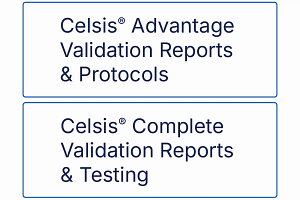
We’ve harnessed the power of our global support network, our entire portfolio, and our industry-proven expertise in alternative, rapid microbial methods (RMM) to provide custom-tailored support options depending on your microbial method validation strategy, your capabilities, and your product. Get faster implementation via two new validation support packages to demonstrate method equivalency, method validation for microbial limit test, specificity, ruggedness, robustness, and method suitability of the Celsis rapid microbial detection method using Celsis AMPiScreen® (Amplified ATP-bioluminescence) in presence of your drug product. In the past two years, we worked with over 40 manufacturing and service laboratory networks to facilitate validation and accelerate their timeline to routine testing with our Celsis® Advantage and Celsis® Complete and microbial method validation packages.
Alongside our validation packages mentioned earlier and in response to the new USP <73> regulatory requirements, we are pleased to assist you in implementing Celsis for your short shelf-life products. Find all the details here.
Although in-house expertise forms the foundation of a strong RMM validation strategy, most labs still struggle with planning, scheduling, and executing implementation activities and often feel overburdened by the testing and additional workload.
"Our collaboration with the Charles River team was instrumental in seamlessly validating and implementing the Celsis® technology. Their expertise ensured that we met rigorous compendial standards and established a reliable framework for routine testing, reinforcing our commitment to excellence in pharmaceutical quality."
Philip Smith, Director of Laboratory Services, Fagron Sterile Services

Explore the Celsis® Rapid Microbial Detection Brochure
Gain insight into Celsis® technologies, platform capabilities, implementation considerations, validation support, and microbial detection applications across a range of product types.
Access the Brochure
Total Rapid Microbial Method Validation Solutions
Realizing the need for better knowledge of the alternative method, we have harnessed our expertise and capabilities across our global network of laboratories to address it. We provide the ability to fully outsource method validation for microbial testing in presence of product for customers seeking to implement Celsis rapid microbial detection in their labs. Testing is performed at cGMP-registered laboratory in Charleston, South Carolina, cGMP-certified laboratory in Dublin, Ireland, laboratory in Kaarst, Germany, or at our cGMP-registered laboratory in Singapore.
Each package includes the same validation reports to begin the validation process for equivalency, robustness, ruggedness, and testing protocols for sample effects testing. From this foundational dataset, the two options allow you to decide to have us perform the testing with your submitted product lots on your behalf, or perform the testing yourself using our complete testing protocols.
Which Microbial Method Validation Package is Right for You?
Each has its own benefits, but only one is right for your laboratory’s goals. Check out our comparison chart to get the details.
Compare the Packages
Celsis® Equivalency Validation Report
As the core piece of each of our microbial method validation solutions, the equivalency report structure was finalized in collaboration with a leading pharmaceutical manufacturer. The Celsis equivalency validation report is provided in a regulatory-ready format for submission by customers seeking to implement a rapid sterility method.
-
Benefits of the Celsis Equivalency Validation Report
- Decreases implementation time by eliminating the need to re-demonstrate equivalency to the compendial method
- Reduces the need and costs attributable to personnel, resources, and time to validation
- Speeds implementation of Celsis rapid microbial detection for sterility via its regulatory submission-ready dataset
- Enables personnel to focus on other aspects of the microbiological method validation process
-
Celsis Sterility Equivalency Report Product Details
This report demonstrates the equivalence of the Celsis AMPiScreen® rapid microbial method after 6 days of incubation compared to the compendial sterility test method after 14 days of incubation for the qualitative screening of a pharmaceutical product for microbial contamination, as described in USP <71>, Ph. Eur 2.6.1, and JP 4.06. As part of the equivalency study, the limit of detection (LOD) and specificity were also demonstrated.
Product: The Celsis® Sterility Equivalency Report Format: - Delivered on purchase as an individually licensed PDF
- Hard-copy print version available upon request
Report Contents: - Test methods and materials utilized
- Statistical analysis and explanation of methods employed
- All raw data and Celsis® instrument workload reports
- Definitive conclusion on equivalency, limit of detection, and specificity
-
The True Cost of Rapid Microbial Method Validation for Microbial Testing
Method Validation Timeline
Typically, even an experienced validation team can spend 6 – 12 months proving the performance and functional equivalence of the alternative method without the presence of their product. While time is often the most visible factor to labs undergoing method validation for microbial testing, labs must also consider cost.
While in-house testing should be performed in order to ensure working knowledge with the alternative method, the instrument supplier can provide solutions to reduce the time and cost between installation and routine use.
Method Validation Material Costs
The additional costs for performing equivalency validation have a significant impact on the overall capital expense of implementation of an RMM, but are often not fully considered. A lab should address costs concerning:
- Technical staff and personnel resources in the project planning, authoring of protocols, execution of testing, results analysis, and report writing
- Reagent and consumable costs required by the rapid microbial method system
- Test materials, including growth media, commercially available organism preparations, or in-house isolates
- It is not unreasonable for a lab to consider these costs down to sterile pipette tips. Although these seem trivial since they are used so routinely, a single case of 1,000 tips can cost approximately $75 – $100. This can equate to several thousand dollars in pipette tips alone when considering how many tips can be used in preparing and executing over 500 samples in duplicate, and preparing cultures, dilutions, transfers, and controls.
- Equipment allocation and usage with respect to current, routine laboratory testing
Typically, it is safe to also account for an additional 20% added cost for potential re-work. Since equivalency is typically performed first, a lab should account for invalid tests due to inexperience with the new rapid system.
Frequently Asked Questions (FAQ) about Celsis® Rapid Microbial Method Validation
-
Is Celsis rapid microbial detection equivalent to the traditional or compendial test method?
Yes, provided in our Celsis Advantage and Celsis Complete microbial method validation packages, the equivalency report and data package demonstrate method equivalency for sterility testing.
-
Has Celsis been accepted by regulatory authorities for rapid sterility?
Yes, it has been accepted by many regulatory authorities globally, including the United States Food and Drug Administration (FDA), European Pharmacopoeia (Ph. Eur.), Japanese Pharmacopeia, European Medicines Agency (EMA), and more using the approach and data included in our Celsis Complete and Advantage microbial method validation packages.
-
How do I obtain regulatory approval for Celsis?
Pharmaceutical companies must work directly with their local regulatory authority and regional authorities where they provide their therapies. We recommend contacting them directly to begin the process and keeping them involved as they are also advocates for the pharmaceutical microbiology industry adopting modern methods. Certain regulatory agencies, such as the United States FDA also assist with pre-submission meetings.
-
How long does method validation for microbial testing and implementation take?
Historically, organizations would expect a minimum of two years to complete the entire project of implementing a rapid method. With the introduction of our Celsis Complete offering, a leading pharmaceutical company was able to implement Celsis in 9.5 months, from inception to approval, in 2021 for a widely used sterile injection. This was made possible by the efficient performance of testing in presence of product performed by our experienced laboratory personnel through Celsis Complete. Additionally, we now offer testing services to quickly onboard additional products to rapidly expand their application of Celsis to their entire product line.
-
How much does method validation for microbial testing and implementation cost?
This depends on the route your organization takes and can vary depending on your lab’s proficiency in quality control practices. If electing to proceed on your own, we recommend evaluating your group’s experience in authorizing microbiological method validation protocols and reports, as well as performance standards in performance testing. If utilizing our Celsis Complete microbial method validation package offering, much of this burden, including costs, can be reduced by allowing our expert laboratory personnel to perform a large portion of your testing, which would significantly reduce the cost of validation in-house.