
Translational models and readouts for epilepsy studies
Epilepsy and related disorders are characterized by seizures, which are the clinical manifestation of abnormal synchronized neuronal activity. Seizures can be caused by traumatic brain injury, brain tumors, stroke, or infection, or in rare cases by single gene mutations. During seizures, synchronizations of neuronal activity can result from decreased resistance of excitatory neurons to firing, upregulation of excitatory transmission, and/or down regulation of inhibitory circuits. Classification of seizures includes focal or generalized, tonic-clonic (limb contraction followed by a shaking phase), tonic or clonic, and myoclonic (muscle spasms in groups or isolated muscles).
Our expertise in neuroscience drug discovery supports the development of new epilepsy treatments, with a wide range of readouts and endpoints across screening and lead optimisation, compound efficacy studies, in vitro models of epilepsy, and epilepsy animal models.
- Cell line generation for screening and compound profiling
- High-throughput screening services including manual and automated ion channel screening against pre-selected panels of ion channels related to epilepsy and seizures
- Mixed GABAergic and glutamatergic iPSC-derived neuronal cell co-culture models
- Detection of seizure-like activity in cell culture with multi-electrode array (MEA) electrophysiology
- Patch clamp and MEA electrophysiology detection of seizure activity
- Video-EEG telemetry and behavioral Racine scoring for seizure detection and characterization
- Preclinical imaging including non-invasive neuronal activity and seizure detection with fMRI in rats and functional ultrasound (fUS) in mice
- Microdialysis combined with bioanalysis of samples, to measure neurotransmitters and metabolites, and for PK/PD of novel therapeutics
Achieve End-to-end Success for Your Epilepsy Drug Discovery Program
View this webinar to learn how epilepsy therapeutic projects are designed with the end in mind and how our scientists generate decision-making data across the drug discovery process.
Watch the Webinar
Epilepsy Animal Models
Our neuroscience experts can guide you in the selection of the most appropriate epilepsy animal model and translational readouts for your epilepsy drug discovery studies. We offer chemically induced seizure models involving systemic administration of either pentylenetetrazol (PTZ) or kainic acid (KA).
PTZ causes generalized seizures through its action at the picrotoxin binding site of GABAA receptors, leading to disinhibition via GABAergic circuits. During functional MRI, intraperitoneal injection of PTZ causes an immediate increase in neuronal activity that translates into BOLD signal increase in the areas involved in seizure propagation. This can be inhibited by benzodiazepine pre-treatment as shown by the change in BOLD response amplitude and time to peak of that response. This experimental set-up can be used to examine the ability of test compounds to block PTZ-induced seizure activity in an epilepsy animal model using a high-resolution, translatable, and non-invasive method. The video below shows seizure progression following PTZ administration in a rat.

KA is a selective agonist of ionotropic kainate glutamate receptors, and so increases activity of excitatory glutamatergic circuits. Systemic administration results in seizures characterised by myoclonic jerking movements, tonic convulsions and tonic limb extension, and producing an epilepsy animal model of tonic-clonic seizures. Direct administration of KA in the hippocampus is used as a model of focal temporal lobe epilepsy.

Functional ultrasound with slow kainic acid infusion challenge can be used to assess the pattern of hippocampal activation and seizure threshold in both acute and chronic epilepsy models. The setup is optimized to allow minimally invasive and repeatable monitoring of response modulation by anticonvulsive or antiepileptogenic treatments. This video shows strongly localized, gradual hippocampal activation (rCBV increase) in a chronic epilepsy model upon slow KA infusion until the seizure threshold is reached, and thereafter periods of ictal hyperperfusion (seizures, spreading/generalized ) are observed, followed by postictal hypoperfusion.
In vitro and ex vivo models of epilepsy
Cell culture and ex vivo models allow for screening of compounds for anti-seizure activity before proceeding into animal models, to refine from hits to leads and assess lead efficacy. Seizure-like activity can be chemically induced in a co-culture model of iPSC-derived glutamatergic and GABAergic neurons with primary astrocytes, and detected by MEA electrophysiology. This model can be used to examine the ability of novel therapeutics to reverse seizure-like activity induced by picrotoxin, a GABAA receptor antagonist, with the anti-seizure medication cenobamate used as a positive control.
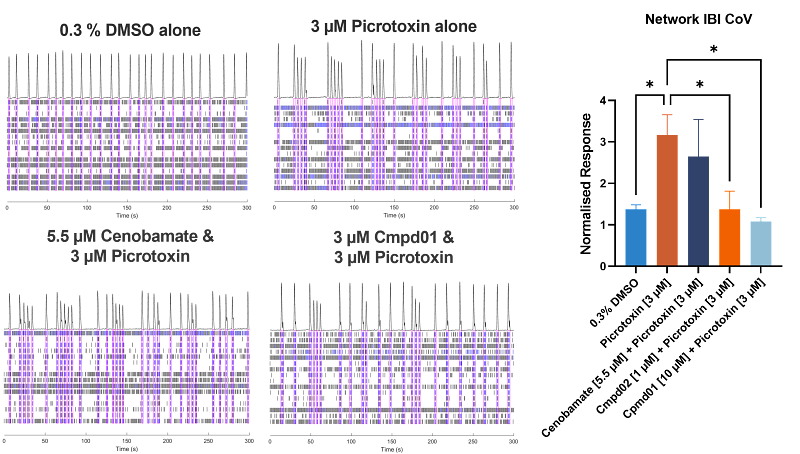
This data shows Raster plots generated by MEA of neuronal activity in a culture of human iPSC-derived GABAergic and glutamatergic neurons with primary astrocytes. Picrotoxin induced seizure-like burst activity, which can be attenuated by cenobamate as a positive control and test compounds, measured by the inter-burst interval coefficient of variance (IBI CoV).
Frequently Asked Questions (FAQs) About Epilepsy Animal Models
-
What causes epilepsy?
Affecting around 1% of the global population, the majority of epilepsy cases are of unknown origin but can be caused by traumatic brain injury, infection, stroke, or brain tumor. Epilepsy includes a heterogenous group of rare disorders called developmental and epileptic encephalopathies (DEE), which are largely developmental disorders characterized by seizures and abnormal cognitive development, for example Dravet syndrome and tuberous sclerosis complex.
-
Why are new treatments needed?
While antiseizure medications are generally inexpensive and widely available, they only control seizures in around 70% of patients, leaving a large population of untreated people. Also, the prevalence of CNS-related side effects means a proportion of patients find antiseizure medications intolerable and so stop taking their treatments.